



How to Get Rid of Carpenter Ants
There are over 12,000 types of ants in the world. These species can be broken down into two distinct groups: those that are annoying but pose no threat and those that cause significant property damage.
In this article, we will focus on the latter. We will teach you how to get rid of carpenter ants before they damage your home.
March 28, 2024
During the warmer months, both your indoor and outdoor spaces run the risk of becoming homes to a variety of creepy crawlies - especially ants.
There are the little black sugar ants that mysteriously find their way into your home in search of the tiniest crumb that you may have accidentally spilled on the ground (mostly harmless, but they do carry bacteria).
There are also red ants and other ants that bite which can be a concern for children and those with allergies.
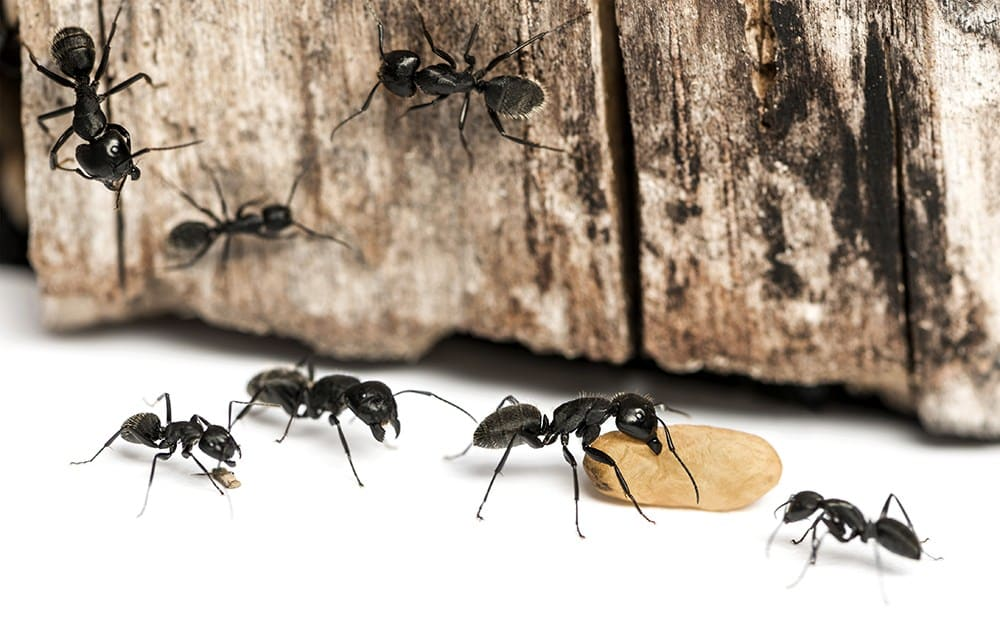
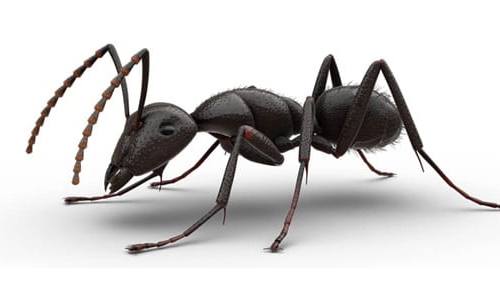
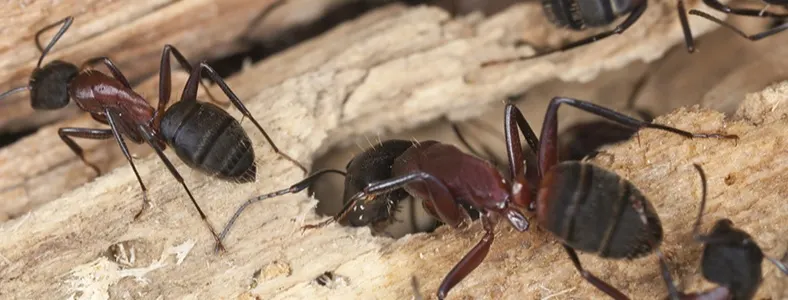
Then there are the enormous carpenter ants. These pests love to damage your house from the inside out during the course of the summer. On top of that, these pesky creatures also like to bite humans.
If these truly unwelcome house guests have infested your home or yard, below you will find all you need to know to get rid of carpenter ants.
For additional information: Carpenter Ant Identification and Inspection
How to Get Rid of Carpenter Ants Outside
There are a variety of strategies you can deploy to solve a carpenter ant infestation. Here are our top five methods for getting rid of carpenter ants:
Use Toxic Bait to Get Rid of Carpenter Ants Quickly
Treat Nests with Direct Dusting
Try Boric Acid
Get Rid of Carpenter Ant Scent Trails
Apply Diatomaceous Earth
1. Use Toxic Bait to Get Rid of Carpenter Ants Quickly
If the carpenter ant colony is concealed or inaccessible, this strategy is highly recommended.
Head down to your local hardware store, buy poisonous gel bait for carpenter ants, and combine it with a teaspoon of sugar and a teaspoon of milk.
Apply the poisonous bait to entice the carpenter ants out of their nest; they will grab the bait and take it back into the nest. If applied correctly, this method will get rid of an entire carpenter ant population in three days. This is one of the most effective ways to achieve total carpenter ant control.
Eliminating Carpenter Ant Colonies
It is critical to treat carpenter ants with slow-acting bait. If the bait kills carpenter ants as they are returning to the colony, the thousands of ants still inside the nest won't be affected. Select a bait that takes roughly three days to work.
Never spray insecticide on carpenter ants emerging from the nest. This will not affect the ants that are still inside the colony and may even cause them to spread out and build more nests if they detect danger.
Tamper-proof bait stations offer a safe alternative for administering poisonous baits if you have pets or young children.
2. Treat Nests with Direct Dusting
This technique works best when you have easy access to the nest and can directly administer carpenter ant dust to the queen and the entire ant colony. Purchase carpenter ant dust, then apply it to the nest as directed on the packaging.
To get rid of carpenter ants quickly, try D-Fense Insecticide Dust. It is an effective and fast-acting chemical dust, but it does contain toxic chemicals that could be harmful to children's and pets' health. So please ensure you apply it safely and correctly with a duster.
3. Try Boric Acid
Boric acid is a powerful chemical that can quickly get rid of a carpenter ant infestation. To use this technique, first, visit a garden supply store to get boric acid.
Then you will need to Mix powdered sugar in a ratio of roughly 1/3 sugar to 2/3 boric acid. Pour the mixture into bottle caps and place them wherever you see the carpenter ants.
The ants in the nest will be killed when worker ants bring the acid back to the nest. The ant's body is penetrated by boric acid, which then dissolves inside the ant.
4. Get Rid of Carpenter Ant Scent Trails
Pheromone trails are essential for the movement and discovery of food sources by carpenter ants. You can successfully eradicate this treasure map leading them to your home by cleaning surfaces that ants have walked on.
Disrupt these scent trails by wiping surfaces with a cotton ball dipped in essential oils such as tea tree, cedarwood, or citrus.
Alternately, prepare a solution consisting of one part liquid dish soap and two parts water, then transfer the mixture to a spray bottle. You can also use a solution that consists of equal parts water and white vinegar. Spray the mixture over the trails or inside the nest if you have located it.
5. Apply Diatomaceous Earth
Diatomaceous Earth is a natural substance that gets rid of carpenter ants and other insects by dehydrating them. Diatomaceous earth is an efficient insecticide for getting rid of carpenter ants because it breaks down the black ants' tough exoskeleton.
Diatomaceous earth, in contrast to other desiccant products, is available for purchase and application in the comfort of one's own home because it is a completely organic pesticide.
Be very careful when handling this product because breathing in the dust could cause damage to your lungs. This product does not pose a threat to either pets or children, but you should still exercise caution.
Applying diatomaceous earth should be done in the same manner as applying boric acid dust, which is to drill holes measuring one inch in diameter every six inches and then blow the dust into the holes.
When applied correctly, diatomaceous earth has the potential to get rid of carpenter ant nests naturally and quickly.
Best Baits to Get Rid of Carpenter Ants Quickly
1. Maxforce Fleet Ant Bait
Maxforce Fleet is a Fipronil-based gel with a high moisture content that eliminates ants in three to five days. Carpenter ants that ingest sugar will consume it, store it, and then vomit it later to distribute it to other ants. Wherever you observe the ants running, inject a little dose of Maxforce Fleet using the bait injector or syringe applicator.
2. Advance 375A Ant Bait Gel
The Advance 375 A Ant Bait provides the carpenter ant with the protein-based food that it requires. Use this if they are feeding on sugar or carbohydrates in your home.
3. Carpenter Ant Bait Combo
This Carpenter Ant Bait Combo Pack combines Advance 275A and Maxforce Fleet into a single kit to maximize savings.
Identifying Carpenter Ants
What are Carpenter Ants?
There are several areas in the world where carpenter ants are naturally found. They construct their distinctive, smooth nests outside in wet, decaying wood. They do this by removing pieces of wood to make galleries, which are pathways through the grain of the wood that lead to various nesting locations.
Nesting sites for carpenter ants can be found anywhere inside that has a natural cavity or hollow, including doors, window sills, tree branches, and wall voids.
How To Identify Carpenter Ants
Carpenter ants, in contrast to termites that eat wood, do not consume wood; yet, they do cause damage to the wood in a variety of ways, including hollowing out trees and wreaking havoc on wood inside buildings.
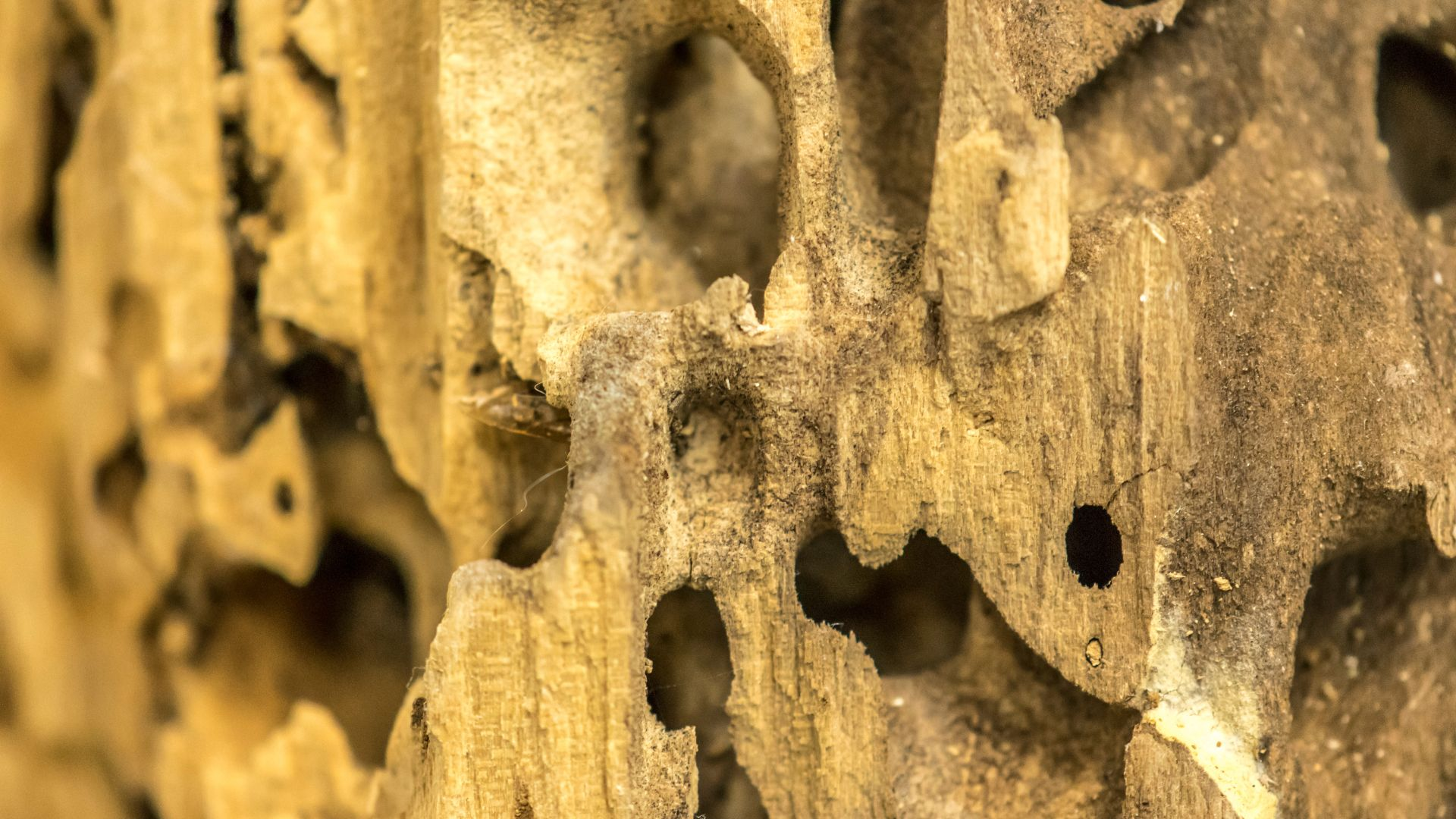
Frass is very fine sawdust that is left behind by ants after they have finished building their nests, and if you look for it, you might be able to figure out where they have been nesting. This is your first step to successfully getting rid of flying carpenter ants and crawling ones too.
How to Inspect for Carpenter Ants
5 Steps to Find the Carpenter Ant Nest and Get Rid of It
Step 1 - Make sure you have Carpenter Ants, not Termites
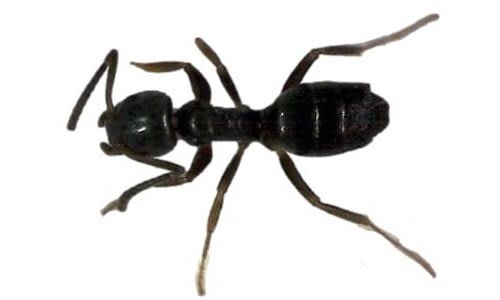
Verify that you are dealing with ants and not termites in the situation. Carpenter ants are large insects that can be black or dark brown in color and have three body segments and six legs.
They have antennas that curve inward. The reproductive carpenter ants have wings, however, the worker ants do not. Termites, which are a much more serious problem to have, have antennae that are straight and bodies that are a light tint.
Step 2 - Look for Frass
Frass is a substance that resembles sawdust and is produced when ants drill into the wood in order to construct their nests. It will appear to be a mound of light wood shavings, despite the fact that it will contain pieces of garbage and other waste.
If you notice something like these wood shavings about your home, it is a clear indication that you have an infestation on your hands and you need to get rid of carpenter ants.
Step 3 - Look for Wood Damage
Ants will chew cuts or holes into the wood to make a nest. In most cases, there will also be frass spread in the surrounding area. Carpenter ants frequently build their nests inside hollow doors, walls, cabinets, beams, and other types of structural wood.
Carpenter Ants prefer to establish their nests in damp wood, so you need to look for spots in the wood where it is somewhat moist. You may find ants have infested a rotting tree outside your home. Continue reading to learn how to control carpenter ants inside a tree.
Step 4 - Place bait in the area
In order to find the nest, you will first need to lure the ants out of the nest with some bait that attracts carpenter ants, then follow them back to their nest in order to determine exactly where they are hiding. Place little pieces of honeydew melon or other sugary fruits in close proximity to where you think the nest is located.
Step 5 - Follow the ants to the nest.
When you see that the ants have taken the bait, track them back to their colony. You will probably see them squeezing through a crack in the wall, the floor, or a doorway.
If the nest can be seen and reached, you can eliminate the nest itself before moving on to the next phase in the process.
If the nest is difficult to find and access, you should consider using poisonous bait to get rid of the carpenter ants instead of trying to find and destroy the nest. The change won't take effect for around three days.
How to Prevent Carpenter Ants from Coming Back
Once you successfully get rid of black carpenter ants, the last thing you want is to have them come back and re-infest. Below we have listed 4 crucial tips to get rid of carpenter ants for good and prevent them from coming back.
1. Remove clutter from your home
Get rid of any clutter and mess to prevent carpenter ants from using it as a nesting place. To accomplish this, thoroughly clean the flooring, mend any leaks that could cause the wood to rot, and clear away any clutter that could provide them with a place to hide.
2. Make sure your home is sealed
You may prevent ants from entering your home by using caulk to plug cracks in the foundation, as well as crevices around entry points. Put screens on your doors and windows to keep carpenter ants out of your home.
3. Clean up any natural debris around the house
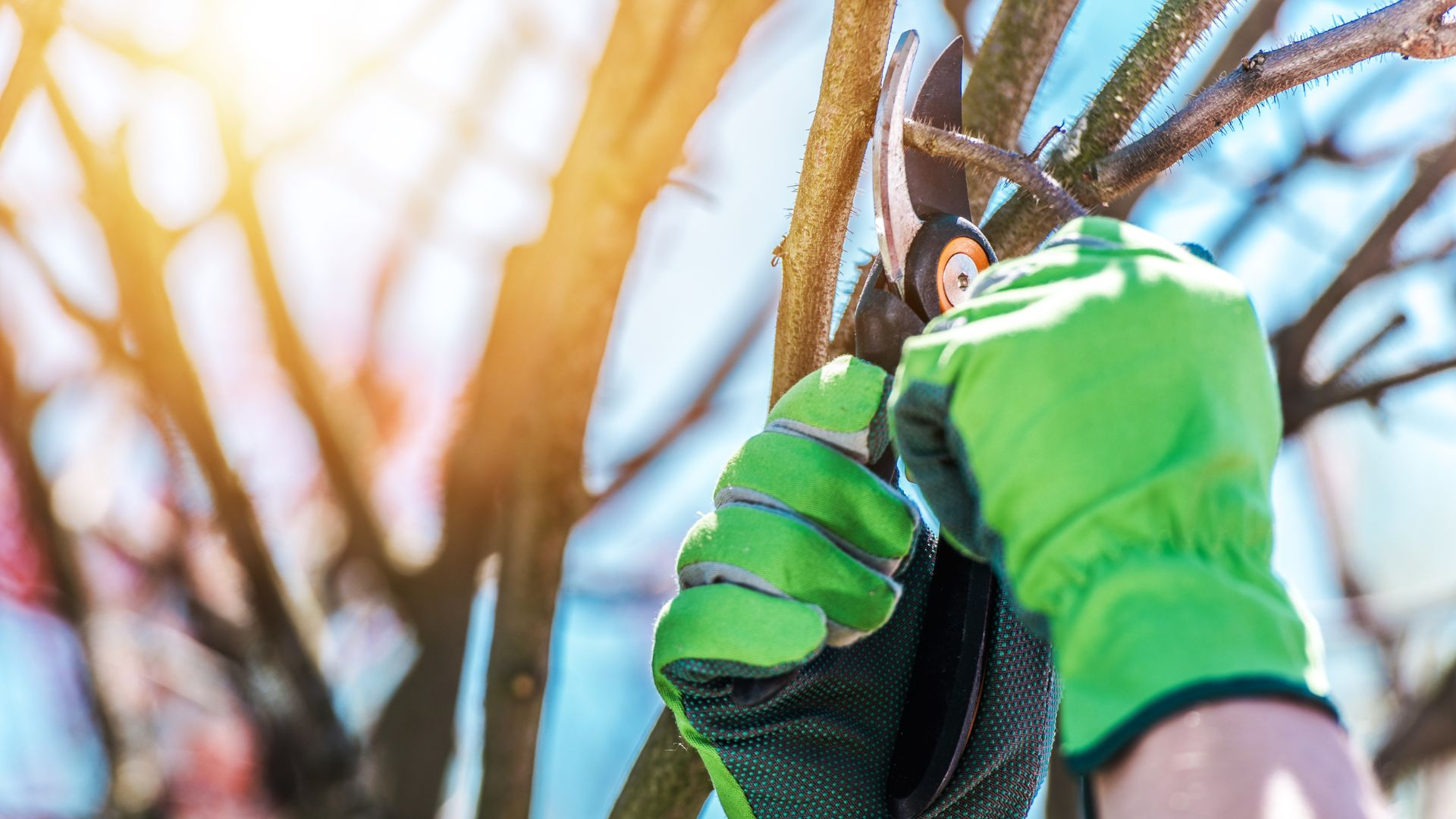
Reduce the height of any tree limbs that hang directly over your home by cutting them back. It is important to get rid of carpenter ants on trees around your home because they could enter on overhanging limbs. You should also remove any weeds, old wood piles, and natural debris, because they may be housing an ant colony.
4. Sweep up food crumbs, clean spills, and fix any leaks.
In order to exist, ants require sugar, protein, and water as food sources. Keeping these fundamental requirements away from them is the most effective strategy to stop carpenter ants from infesting your property.
Make sure there are no crumbs on the floors or countertops and clean up any spills, especially those involving sugar. Make sure there is no water that can be accessed in the area and fix any leaking faucets.
Take the Next Step in Carpenter Ant Control
Don’t wait for the problem to worsen! Take back control with DIY solutions tailored to your specific infestation. DIY Pest Control has everything you need to get rid of the carpenter ants in and around your home!
Shop Carpenter Ant Control ProductsHow To Get Rid Of Carpenter Ants
Learn how to identify carpenter ants and the damage they cause. We'll teach you how to get rid of them inside your home and outside.

Learn how to identify and get rid of carpenter ants. The first step is to identify and look for carpenter ant signs and/or carpenter ant damage. After that, you can determine how to treat and control carpenter ants yourself with professional ant control products.
Carpenter ants are indigenous to many parts of the world. They nest outside in dead, damp wood, building smooth, distinctive-looking nests. They remove wood to create passageways through the wood grain to provide access to various nest areas known as galleries. Indoors, carpenter ants nest in any natural hollow, such as hollow-core doors, window sills, and wall voids.
Unlike termites, carpenter ants do not eat wood; however, they damage wood, from hollowing out trees to damaging the materials used in the construction of buildings. Sometimes you can find their nesting location by observing the presence of frass, the very fine sawdust they leave behind when constructing nests.
Carpenter Ant Identify and Inspection
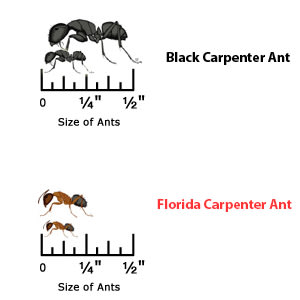
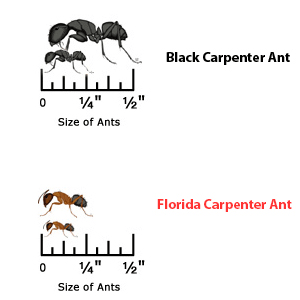
- Carpenter ants are large, from 1/4–3/8-inches long, and are one-node ants.
- They are dark brown to black, but some may have red or yellow coloration.
- The Black carpenter ant, Camponotus pennsylvanicus, in the east, and C. modoc in the west are the most thoroughly studied species in the United States.
- Other species of Camponotus are distributed throughout the country.
- The queens are slightly bigger than the workers.
- The workers of an established colony vary in size.
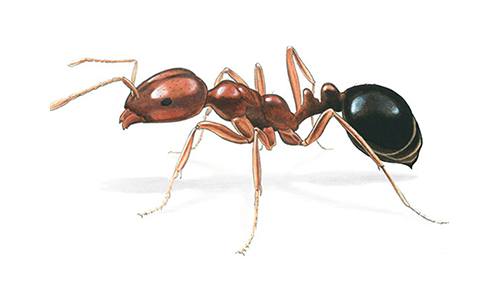
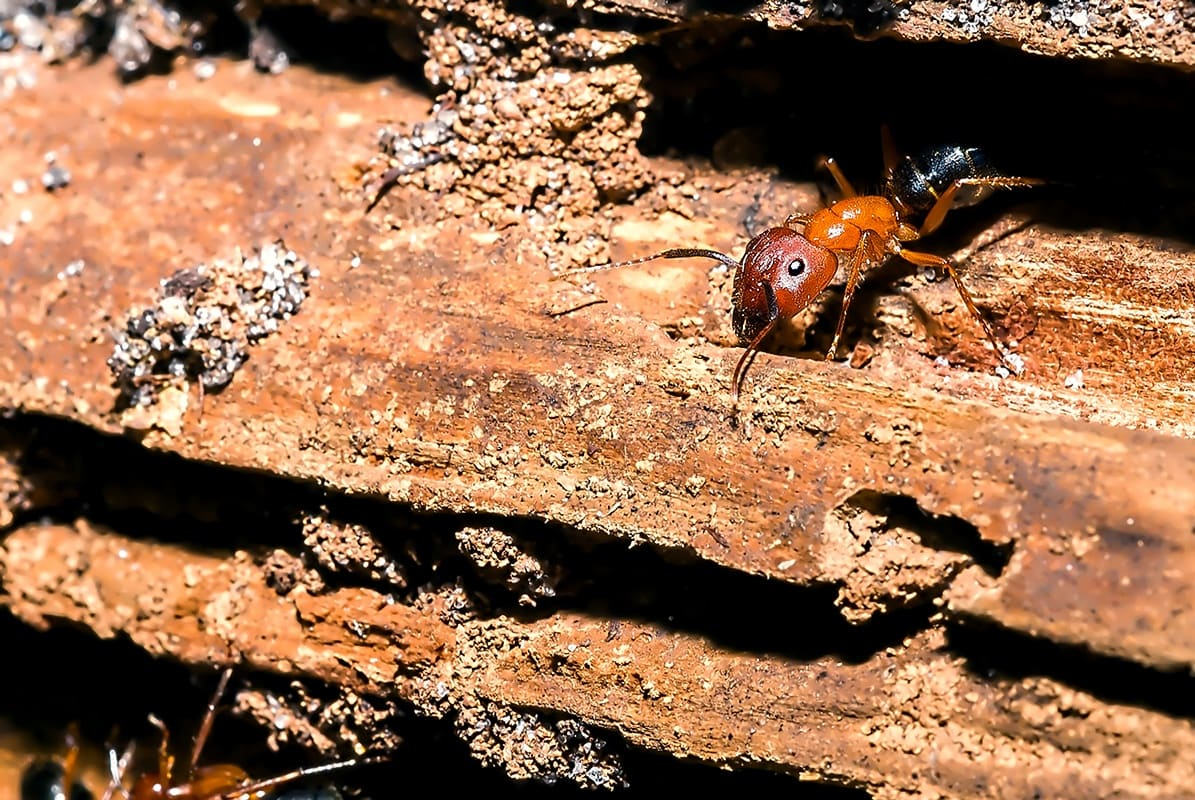
- The most common variety of carpenter ant is large and black, but the Florida carpenter ant is smaller and ranges in color from yellow, red, brown to black.
For More Information:
Carpenter Ant Identification and Inspection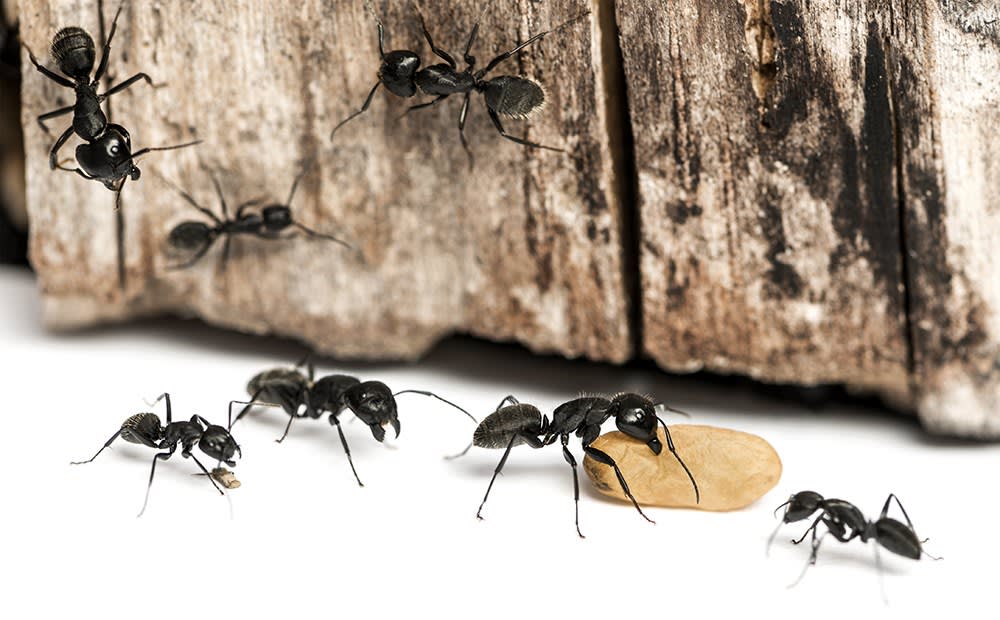
Black Carpenter Ants
Eastern United States: (Camponotus pennsylvanicus)
- Color: All black
- Workers: 1/4–1/2-inch in size
- Queen: Large, over 1/2-inch in size
- Swarming: Colony matures in 3–4 years, swarming occurs in late spring–summer
- Distribution: Mid West to Eastern States
For More Information:
Black Carpenter Ants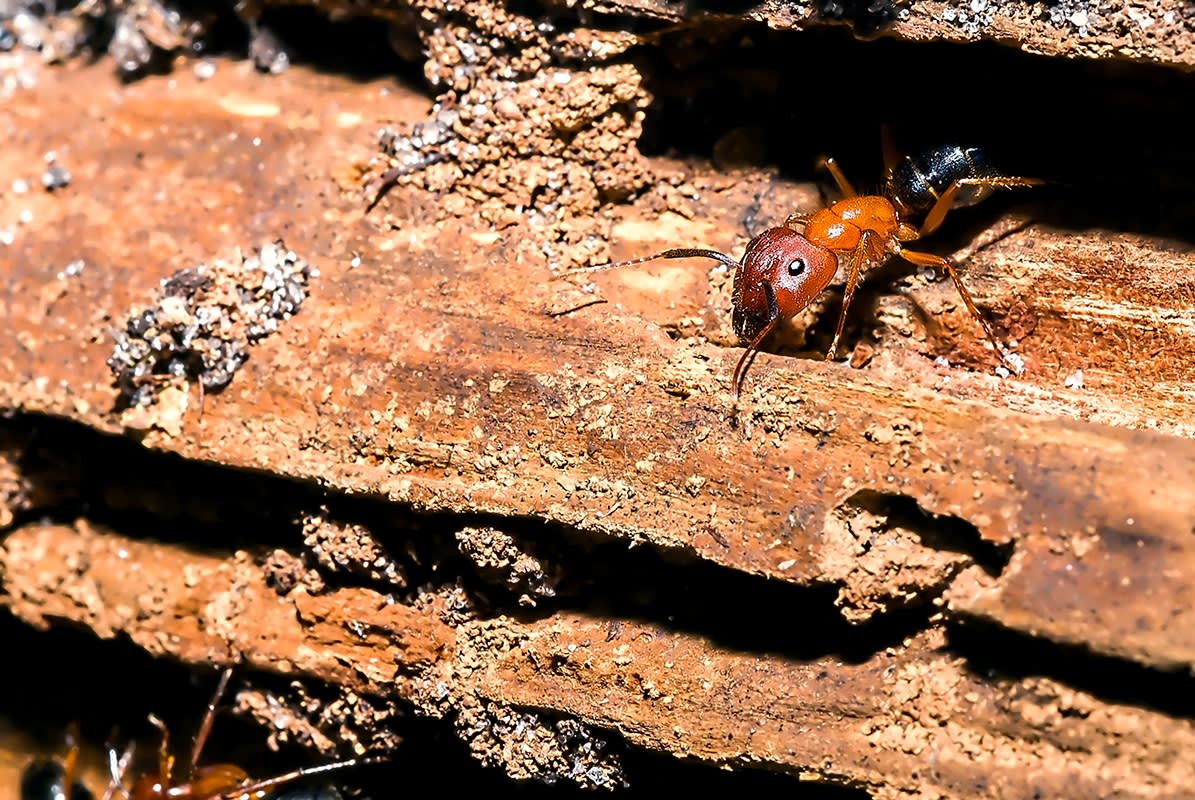
Florida Carpenter Ants
- Color: Red head, black abdomen, thorax, and legs
- Workers: Smaller, 3/16–3/8-inches in size
- Queen: Large, over 1/2-inch in size
- Swarming: Unmated swarmers in satellite colonies
- Distribution: Florida and southeast U.S. Colony size: Up to 3,500 workers.
- Nests: Seeks to nest in existing voids or excavates soft woods that are rotten and styrofoam.
For More Information:
Florida Carpenter AntsGet Rid Of Carpenter Ants ( 3 Steps )
The first step in carpenter ant control is an inspection. The purpose of the inspection is to determine if they are located outside and simply foraging inside for food or if you have a colony or satellite colony inside your home.
Click Here: Carpenter Ant Inspection Tips.
Once you complete your inspection and identify nest locations and foraging trails, the next step is to determine which control measure to use. Carpenter ants are controlled through the application of insecticides and sprays in various forms. These forms include liquid concentrates, baits, dust, and foams.
- Non-Repellent Insecticides - Used as perimeter spray.
- Baits - Used on Carpenter Ant trails.
- Dust - Used in voids and galleries
- Foams - Used in voids and galleries
The final step is to prevent further infestations by ant-proofing your home and yard, clearing away rotting trees and lumber piles, fixing plumbing leaks, etc.
Click Here: Prevention Tips.
Non-Repellent Insecticide Sprays for Carpenter Ant Control
Spraying Procedures for Foraging Carpenter Ants
At times you will have foraging ants that come inside, forage for food, and then return to their outdoor nests. You can block these foraging ants using a perimeter treatment with a non-repellent residual insecticides such as Navigator SC or Termidor SC also control a wide variety of insects including Termites, Spiders, Roaches, Centipedes, Millipedes, Ticks, and many more.
Baiting Procedures for Foraging Carpenter ants and Carpenter ants in recessed areas.
Apply carpenter ant baits after inspecting their trails. The ant baits listed below are designed to attract carpenter ants. The foraging carpenter ants pick up the bait and share it with the entire colony, killing it.
- Do not put repellent insecticides, liquid or granulated, in the same area as baits unless these insecticides are classified as non-repellents. Repellent insecticides repel the insects away from the baits, rendering the baits useless. Use only non-repellent insecticides in the same area as baits.
- It is important to remove other competing food sources (such as crumbs and pet food) that could interfere with the ants taking the bait.
A good treatment choice is to bait both inside and the ground outside with a combination of baits.
- Both of the baits listed below are designed to allow foraging workers to take the bait to the queen in the nest, eliminating the colony/colonies, thereby preventing future outdoor populations from coming inside. These baits work well on carpenter ants and resist the elements, making them hard choices for outside baiting. Carpenter ants feed on sweet foods during certain cycles, and at other times feed on protein foods.
- Use both baits for a complete balance of Ant's dietary needs.
Maxforce Fleet is a Fipronil carbohydrate-based gel with a high moisture content that gets rid of ants within 3-5 days. If the carpenter ants are feeding on sugar, they will eat it and store it and regurgitate it later to share with other ants. Apply Maxforce Fleet with the syringe applicator or bait injector in small amounts where you see the ants running.
The Advance 375 A Ant Bait is a protein-based food for the Ant's protein needs. Use Maxforce Fleet if they are feeding on sugar or carbohydrates.
Combines both Maxforce Fleet and Advance 275A in kit forms for greater savings.
Carpenter Ant Bait Products
Use Dust To Apply Into Void Areas
D Fense dust is to be used as a dust in void areas. Use a duster with it for the best application.
Use Aerosols To Apply Into Void Areas
Both Spectre PS Aerosol and Alpine Aerosols are non-repellent insecticides with crack and crevice tips. They work well in void areas where you don't know exactly where the nest is located.
The aerosols will flow into the void area.
Use Aerosol Foam To Apply Into Void Areas
Fuse Foam and Alpine Foams are non-repellent foam insecticides. Fuse Foam has a 30:1 expansion ratio to foam into ant and termite nests and galleries and structural voids. It's great for getting into hard-to-reach areas.
Treating the Voids (Colonies Inside a Hollow Area)
Indoor nests (voids) are found in hollow doors, window sills, behind baseboards, or other natural hollow areas. These are the areas that warrant a complete inspection. Indoor carpenter ant damage oftentimes indicates water damage and wood decay. Making necessary repairs will help prevent re-infestation. If you suspect the nest is in a wall, drill and treat at least 2–6 feet on either side of where the Ants are entering in order to maximize the opportunity to contact the nest directly, so you can get the queen.
Note: Do not use a liquid insecticide in a wall void. Treat wall voids and other hidden spaces where Ants hide by carefully drilling a series of small (1/8-inch) holes and dusting the area with a residual insecticide dust such as D Fense Dust. You can also use a non-repellent aerosol with a crack and crevice tips such as Spectre PS Aerosol, Alpine PT Aerosol, or foaming aerosol such as Alpine Ant Termite Foam. These methods provide a long-term residual effect.
WARNING: Never use liquid insecticides or metal-tipped devices around any electrical outlets.
Carpenter Ant Prevention
Follow these steps to prevent carpenter ant infestations:
- Correct moisture problems, roof leaks, and plumbing leaks.
- Cut back tree limbs or branches that could serve as a bridge to your structure.
- Seal cracks and openings around the foundation, especially where utility pipes and wires enter from the outside.
- Stack firewood away from the house, elevated off the ground if possible. Carpenter ants love to nest in firewood.
- Contact Us for further information and help with your carpenter ant issue. 1-800-476-3368