




Clover Mites and Clover Mite Control
Learn how to get rid of Clover Mites with professional Clover Mite treatments.

Clover mites are tiny red mites that can swarm in the thousands when the weather is right. These mites do not bite but can be quite a nuisance when they enter a house; each mite is squished, producing a red mass. Clover mites feed on vegetation and feed on the algae that grow on mulch, rocks, and underneath the siding of your house. Removal of leaves and mulch from around your home will reduce any pest populations.
Identifying Clover Mites
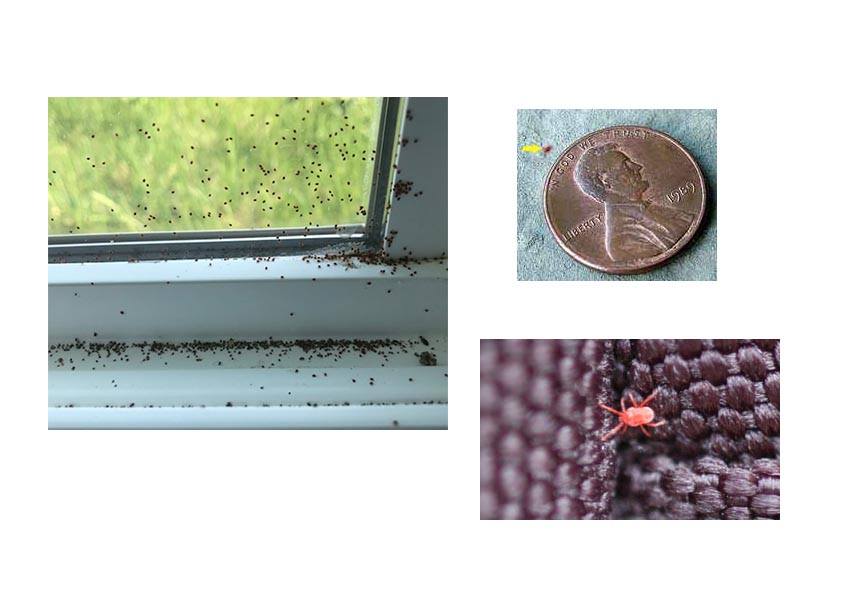
The full-grown clover mite is slightly smaller than a pinhead and has a bright reddish to reddish-brown body. Clover mites typically appear in large numbers.
Clover mites look like dark red specks crawling around siding, doors, windows, drapes, curtains, and furniture. When crushed, clover mites leave a red stain. The stain is not blood; it's just their natural color.
The front legs are as long as the body and extend forward.
- Clover mites are an arachnid, a close relative of spiders and ticks.
- Clover mites leave a red stain when crushed.
- Clover mites feed on grasses, clovers, and certain other plants in the lawn and around the home.
- They often crawl into cracks and crevices to molt and lay eggs. Typical "hiding places" are under the loose bark of trees, on foundation walls, beneath siding, and around window frames.
- Clover mites do not damage buildings and furnishings, nor do they injure humans and pets.
- They attack several kinds of grass and plants found in yards.
- Clover mites are plant feeders that have been found infesting more than 200 different plants. They suck the sap.
- They can live off algae and mold.
- Clover mites live close by and on their food sources.
- They become a real nuisance upon migration into buildings.
- Heavy migrations of clover mites into houses are common in the early summer and fall.
- Clover mites build up large populations around structures surrounded by lush, well-fertilized lawns and shrubbery.
- Large populations of clover mites may occur on commercial buildings' flat roofs and are associated with moss growth.
- Clover mite females lay about 70 eggs each.
- They lay eggs in the crevices of buildings, under sidings, and on the underside of bark at trees' bases.
- Clover mites eggs do not hatch below 40 degrees F or above 86 degrees F.
- They lay their eggs during the spring.
- After the eggs hatch, the newly emerged immature clover mites move to find hosts, molt, and pass through two nymphal stages.
- Clover mites in the egg stage may either hibernate (overwinter) or become dormant during the summer. They hibernate under tree bark, in cracks of fence posts and foundation walls, under the sheathing buildings, or in other dry, protected sites, during adverse weather conditions.
- Clover mites are most troublesome in early spring and again in fall, especially on the east and south sides of buildings.
- They can be found randomly throughout the house but very frequently on the south side of the house because of the warmth.
- Lincoln-Nebraska Extension: Clover Mites
Clover Mite Biology and Habits
Clover Mite Chemical Treatments
If the mites have already invaded the home, causing an infestation, chemical controls, such as Bifen IT will solve the problem.
Bifen IT can be applied to lower foundational exterior walls up to the first-floor window. A 10 to a 20-foot wide strip of nearby lawn where the mites are found during their invasion period should be sprayed also. Thorough treatment is required for consistent results. Sprays are usually applied at the rate of 15-20 gallons of finished spray per 1,000 square feet.
Hose End Sprayers make the job much easier and helps with consistent application.
Spray the walls and foundation to the point of runoff and the vegetation until it is entirely wet.
Use a vacuum cleaner inside the structure to pick up the live mites. Dispose of the vacuum bag.
Get Rid Of Clover Mites-Control Measures
Clover Mite Mechanical Treatments
- The most effective prevention is removing any grass and weeds up to 24 inches away from the house's foundation.
- Placing a plant-free band of gravel, coarse sand, marbles, lava rock, or wood chips around the foundation helps keep clover mites away from the structure. Clover mites have difficulty crossing such barriers.
- Avoid excessive watering and fertilization near the structure to avoid host plants' lush growth close to the house.