




Get Rid of Flesh Flies
If you have a flesh fly infestation, follow this guideline to get rid of flesh flies.

Flies in the family Sarchophagidae are the "Flesh Flies," so-called because many species lay their eggs in open wounds. Flesh flies don't often enter houses or food-handling establishments in large numbers. The female flesh fly lays her eggs on meat scraps or dog excrement. They may be found in dog runs.
Flesh flies primarily breed in animal carcasses. Flesh flies, as well as blow flies and bottle flies, are the first insects at a dead animal carcass.
Forensic entomologists use the larvae of flesh flies collected at the site where a murder victim is found to help pinpoint the time of death.
Identification and Inspection
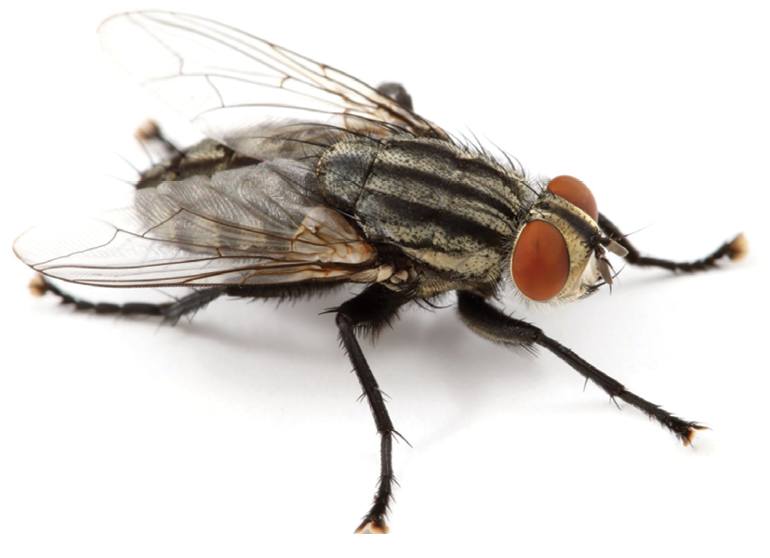
Flesh flies are medium to large-sized flies and usually have three dark thoracic stripes and mottled abdomens. Many of the common species have a red tip on the abdomen.
Though some species may be smaller than house flies, most flesh flies are about 1/3 to 1/2 inch long.
Due to their markings and coloration, sometimes House Flies are confused with Flesh Flies. Flesh flies are larger than house flies. Flesh flies have a checkerboard pattern on top of their abdomen and are gray.
Inspection
Flesh flies generally do not infest structures in large numbers or with any regularity. Flesh flies will be attracted to buildings by odors emitting from the dumpster or the building itself. Rendering plants and meat processing facilities may attract more flesh flies than other types of facilities such as a hotel or hospital.
Occasionally, one or more flesh flies will manage to enter the building. If this is the case, try to determine if a breeding source is located near the building and how flies might be entering the structure. Accumulation of garbage under a dumpster is a common breeding source for flesh flies near buildings.
Sometimes, a large number of flesh flies will suddenly appear in a particular area inside a building. These flies are most likely breeding inside a dead rodent or bird inside a wall, false ceiling, or the attic. Mature larvae may be found crawling about the area. These larvae have left the breeding source in search of a place to pupate.
Most Flesh flies' infestations can be attributed to garbage or rodent carcasses found in or underneath trash dumpsters. Most infestations of indoor Flesh flies are small in numbers. They can be traced to dumpsters, meat processing plants, or rendering facilities located nearby.
Suppose large numbers of these pests are found indoors. In that case, it can usually be attributed to a dead animal such as a rodent or bird. Backtracking the fly maggots' paths will often help locate the carcass or source of indoor Flesh fly infestations. If fly larvae are located in light fixtures, an inspection of the attic and nearby wall voids might be necessary.
Get Rid Of Flesh Flies
Recommended Control and Elimination Measures for Flesh Flies
Remove carcasses, any piles of decaying organic material, and manure piles. This removal would destroy any favorable breeding sites. Properly treat animal wounds in order to prevent harm from flesh flies to animals.
Remove dead rodents to eliminate any breeding sources. Practice rodent control methods and rodent exclusion if possible.
If these flies manage to enter a structure, you can use Fly Lights.
Fly light traps attract and capture flies. The number of fly light traps to use will vary according to the building size.
You can also spray a residual treatment like Avesta CS on surface areas that they rest on before they enter the building. Typical sites include the walls and sides of dumpsters and around door entry points.
Flesh Fly Biology
Once the Flesh Fly eggs have been laid on suitable breeding material, the larvae hatch out from the eggs and burrow under a surface.
It is not uncommon to encounter a dead mouse's body, for example, whose body writhes and wiggles as the maggots move about inside while feeding. After growing to maturity within a few days, the larvae crawl out of the breeding material to pupate. The larvae may crawl many feet away from a breeding source inside buildings; outdoors, they generally crawl only a short distance before burrowing into the soil to pupate. The adult flies begin emerging several days later.
Flesh flies retain their eggs within the body of the female until they are ready to hatch. The larvae are deposited directly onto the food that the immature will be eating.
The life cycle for the common species can be completed in 8 to 21 days.
The preferred breeding media around residences are decayed flesh, spoiling meat, and manure. Usually, garbage can meat scraps and dog food left outside are abundant flesh-fly breeding sources. Flesh flies can breed in dead rodents and birds in attics or wall voids of houses.
Adult flies do not bite but feed on a wide range of liquid substances. Most larvae infest wounds, carrion, or excrement. The larvae of some flesh flies species are beneficial because they prey on eggs, nymphs, or larvae of more harmful insects. Lesser house fly larvae, blowfly larvae, and grasshopper nymphs are common hosts of flesh flies.
Flesh fly life histories vary with species and location. They overwinter as pupae in temperate climates. Rarely very numerous, the flies emerge in spring and mate. Eggs are laid only under very unusual circumstances. As a rule, eggs hatch within the body of the adult. Females of most species deposit 20 to 40 larvae directly onto the host or substitute. As many as 325 larvae have been known to be born by a single female.
Flesh fly maggots feed for three or four days and develop through three instars. Soon afterward, these mature larvae enter the pupae stage. Adult flies emerge in 10 to 14 days; the life cycle is repeated. Several generations are produced each year.
Prevent Flesh Flies
Minimize desirable egg-laying spots to prevent flesh flies.
- Remove animal carcasses
- Minimize piles of decaying organic material
- Properly dispose of manure
- Properly treat animal wounds to prevent flesh flies from depositing eggs in the wound.