




How to Get Rid of Pharaoh Ants
Follow these guidelines to get rid of and kill Pharaoh ants

Identification and Inspection
Pharaoh ants are commonly found inside homes in the warmer climates of the southern United States but found throughout the United States. They may be found in homes, grocery stores, hospitals, apartments, hotels, etc.
Pharoh Ant Appearance
Pharaoh ants are small, about 1/16-inch long. They are colored light yellow to a red color, with black markings on the abdomen. Pharaoh ants look similar to Thief ants, but Pharoah ants have three segments in the antennal club. Since they are so tiny, they can travel and trail to many places.
Inspect Nests and Trails
Pharaoh ants, being tiny, can be found in diverse places. Inside, they like to nest in warm areas. Their nests are usually well hidden, and they can forage far away from the nest with trails marked by trail pheromones.
Pharoah ants can be persistent, with large colonies.
Outside
Outside, Pharaoh ants may nest in shaded areas or under debris. In the northern climates, these ants can not survive year-round outside.
Indoors
Indoors, these ants prefer to nest in recessed areas like wall voids, under some appliances, in-wall outlets, and under carpets for protection. If their colonies are disturbed, or the colony becomes too large, they may move.
- Inside they are usually found in the kitchen and bathrooms, but workers are also commonly seen trailing along window sills and baseboards. They are seen traveling along with plumbing or electrical wires, going from room to room.
- Pharoah ant nests include cabinet voids, wall voids, behind baseboards, window moldings, insulation in refrigeration, inside curtain and shower rods, cardboard boxes, and expansion joints in slabs.
- They are found among folds of clothing and sheets, in folded paper sacks and newspapers.
- Look in hollow bed frames, around waterbed mattresses, in irons, and boxes.
- You can see trails of foraging pharaoh ants where water or food sources are available, but their nest may not be nearby. Their nests are rarely found.
- They are also spotted near water sources around countertops, toilet drains, and sinks.
- Pharaoh ants can nest outdoors in lawns and gardens.
- They are found outside buildings where a constant moisture source is present, such as sprinkler systems and evaporative cooling units.
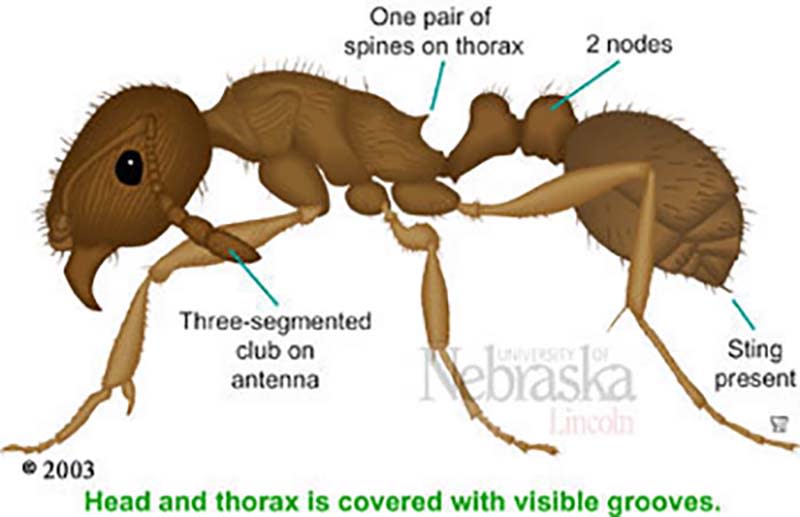
Diet
Pharoah Ants will feed a wide range of foods; they feed on proteins, sweets, and fats. They can feed on both dead and live insects. If choosing baits, consider their complete dietary needs, sweets, proteins, and grease-based baits. Below is our recommended baits for protein/grease and sugar needs.
Reproduction
Pharaoh ants grow from egg to adult in about 45 days. The queens live as long as 39 weeks and can lay about 400 eggs. Workers only live up to 10 weeks.

Regions Found
The Pharoah ant is found throughout the US, but it is widespread in the southern states. It is commonly found in apartments and commercial buildings in northern states, such as hotels and hospitals. These ants may have small colonies and multiple queens and are portable as they nest in boxes and furniture. This "portability" allows these ants to move from location to location in boxes and furniture as carried during moves.
The Pharaoh ant queens and colonies are very mobile. If conditions for survival are not ideal, these ants will move to new locations. They use electric wires and plumbing pipes to travel from room to room and apartment to apartment.
Pro Tips for Pharoah Ant Control
- Pharaoh ants are one of the most common ants in Florida.
- Baiting is the best option, using both sugar and protein-based baits.
- Pharoah ants commonly forage they are near the foundation; use Navigator SC around the foundation and entry points.
- The best bait product for Pharaoh ant control would be the Advion Ant Bait Kit, which has protein and sweet based baits.
Prevent Pharoah Ants
-
Seal us as many entry points as possible. Pharaoh ants will gain entrance through small cracks and crevices, particularly around doors and windows.
-
Practice proper sanitation in the kitchen. Wipe up extra grease and crumbs from counters and floors.
-
Since Pharoah ants like moisture, fix any leaky pipes. Use a dehumidifier indoors if you have high humidity.
-
Eliminate standing water.
-
Piles of firewood may be nesting areas for Pharoah ants; remove them from the house as far away as possible.
-
Remove excess vegetation like shrubbery and tree branches from your home, so they don't use them as a highway to enter your house.
How to Get Rid of Pharoh Ants
Insecticide Usage
Unless you use a non-repellent spray, baiting is the preferred treatment over typical residual spraying. Baiting is the most reliable way to eliminate the entire colony. When choosing ant baits, it is best to choose from both sugar-based baits and protein/grease-based baits. Pharoah Ants may be very persistent and suddenly appear in various places. When placing out the recommended sugar/protein baits, consider the likelihood of the ants changing locations. Pharaoh Ants are mainly a problem inside, so the recommended baits below are for inside use.
If using a spray, choose a non-repellent type unless you are treating the nest itself.
Non-Repellents For Outside and Inside Pharaoh Ant Control
Outside Perimeter Spraying: If you want to stop the ants from coming inside, it is best to stop them with a perimeter residual non-repellent spray. Top recommendations would be Navigator SC (Fipronil 9.1%) outside around the perimeter of your home. Taurus SC is not labeled for inside use, just outside usage.
- If they are inside, as they will go outside, they will cross over the insecticide.
Inside: You would spray on the outside with Taurus SC around the perimeter. Usually spraying the perimeter is enough treatment for Pharaoh ants, and it will help with prevention.
- If you need any insecticide inside, use Spectre PS or Phantom Aerosol in cracks and crevices in the inside areas.
Non-Repellent Ant Kit combines Navigator SC and Phantom Aerosol for greater savings. A complete kit to spray both inside and outside for Pharoah ant control.
Insecticide Usage
Unless you use a non-repellent spray, baiting is the preferred treatment over typical residual spraying. Baiting is the most reliable way to eliminate the entire colony. When choosing ant baits, it is best to choose from both sugar-based baits and protein/grease-based baits. Pharoah Ants may be very persistent and suddenly appear in various places. When placing out the recommended sugar/protein baits, consider the likelihood of the ants changing locations. Pharaoh Ants are mainly a problem inside, so the recommended baits below are for inside use.
If using a spray, choose a non-repellent type unless you are treating the nest itself.
Non-Repellents For Outside and Inside Pharaoh Ant Control
Outside Perimeter Spraying: If you want to stop the ants from coming inside, it is best to stop them with a perimeter residual non-repellent spray. Top recommendations would be Navigator SC (Fipronil 9.1%) outside around the perimeter of your home. Navigator SC is not labeled for inside use, just outside usage.
- If they are inside, as they will go outside, they will cross over the insecticide.
Inside: You would spray on the outside with Navigator SC around the perimeter. Usually spraying the perimeter is enough treatment for Pharaoh ants, and it will help with prevention.
- If you need any insecticide inside, use Phantom Aerosol or Spectre PS in cracks and crevices in the inside areas.
Non-Repellent Ant Kit combines Navigator SC and Phantom Aerosol for greater savings. A complete kit to spray both inside and outside for Pharoah ant control.
Key Takeaway
Avoid splitting the colony and making the problem worse by using only non-repellent sprays and baits for Pharaoh Ant control.
Recommended Odorous Ant Baits (Sweet and Protein/Grease Feeding Cycles)
Why Ant Bait?
The use of residual sprays or dust (not non-repellent insecticides) causes stress in the ant colonies, causing them to split into sub-colonies and scatter. This scattering, also called budding, multiplies the Ant colonies' number and thereby multiplies your ant problem.
When you bait, use a slow-acting bait. Quick-kill insecticides and baits will only kill the foraging ants, not allowing those worker Ants to take the bait back home to feed the queen, nest workers, and brood.
If the ant bait you are currently using is not effective (if the ants are not visiting the bait), you will need to change the bait. Slow-acting baits provide a variety of the foods the ants find in nature. Examples are other insects (proteins/grease-based baits), nectar, aphid honeydew, and plant products (sugar and carbohydrates found in sweet-based baits).
Choosing a bait requires an understanding of the nutritional needs of the colony. To be sure that you have all the baiting needs met, you may want to be ready with a sugar/carbohydrate-based bait, a grease/fat-based bait, and a protein-based bait.
Advion Ant Bait Kit is a combination kit (Contain both protein-base and sweet-base baits)
Protein /Grease Feeding Cycles
The top recommendation from the protein/grease category is Advion Ant Bait Arena (Outside and Inside)
Sweet Feeding Cycles
To recommendation from the sweet feeding category is Advion Ant Bait Gel
IMPORTANT NOTE: Remove all other food competition when baiting alone once the ants start feeding on it.
Various Ants That Invade Homes and Businesses






Written by our resident pest control expert Ken Martin.