




How to Kill Ticks
A guide to get rid of and kill ticks in your house & yard

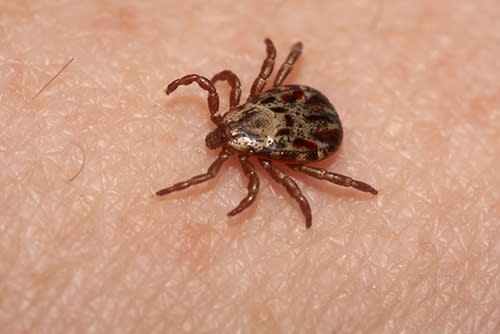
There are several Tick species that vary in appearance, but all of the adults are small, round with eight legs. All ticks feed exclusively on the blood of vertebrates and are blood feeders.
Get Rid Of Ticks-Inside, Outside and on Pets
Inside Tick Treatment
Use Residual Insecticides To Kill Adult Ticks: Recommended residual insecticides inside would be *FenvaStar EcoCap, Wisdom TC, Bifen IT, or Pivot Ultra Plus, or Precor2000 Plus Aerosol. Spray twice the first month every two weeks, then once a month for maintenance.
- Mix the FenvaStar ECO Cap (2 oz per one gallon of water). For additional help, use an insect growth regulator (Tekko Pro IGR) to prevent immature ticks from becoming breeding adults.
- Spray these products at the edges of the room and pet areas (do not spray pets with these products).
- If you have hard floor surfaces, the Pivot Ultra Plus or Precor 2000 Plus Aerosol will adhere to the surface better, and it is ready to use.
- Bifen IT or Wisdom TC is limited to cracks and crevices only, not the whole floor surface area, so it would not be an appropriate product inside for both tick and flea control. Bifen It or Wisdom TC are sufficient for just tick control treatment inside or outside. If you want a product for both tick and flea control, choose FenvaStar EcoCap, Pivot Ultra Plus, or Precor 2000 Plus.
*Fenvastar EcoCap, Pivot Ultra Plus, and Precor 2000 Plus Aerosol may be used for inside flea treatment as well.
- Wash pet bedding or discard their bedding.
- Clean area rugs.
- Steam clean or vacuum furniture where pets rest.
Use Insect Growth Regulators (IGR) To Prevent Tick Development:
- Tekko Pro IGR, with its two active ingredients, prevents the immature tick from developing. Tekko Pro IGR will help reduce the tick population.
- It will work on both fleas and ticks. You will need an insecticide to mix with it to kill the current adult stages of ticks.
- Mix it with FenvaStar Eco Cap or Bifen IT. Use the FenvaStar Eco Cap for flea and tick treatments and the Bifen IT for tick treatments only.
- Mix 1 oz of Tekko Pro with your choice of insecticide.
- We have Flea and Tick Kits with Tekko Pro and Insecticides combined for savings.
Supplement with Quick Kill Aerosols: Non-residual, contact space sprays that contain Pyrethrins such as PT Microcare CS may be useful to supplement the residual sprays. It may be used daily and is a contact killer.
Insecticide Dusts provide long-term control: Drione Dust (for pet bedding) or D-Fense Dust-in cracks and crevices (Not on pet bedding).
Treat where ticks reside:
- Ticks like to reside in crack and crevices; they seek hiding areas for safety.
- behind baseboards
- window and door frames
- upper portions of structures
- localized areas used by dogs
- They will move to avoid detection. Ticks don't have the same type of larvae as the fleas; you do not have to broadcast over the entire surface as you would spray for a flea treatment.
Outside Tick Treatment
- For the outside: Wisdom TC, Bifen IT or Permethrin SFR should be applied to grassy and bushy areas near the house or kennel, the edges of lawns and gardens, under porches, and other areas dog travels or spends time.
- It is usually not necessary to treat the entire yard.
- One way to check the extent and or location of ticks in your yard is to drag a white pillowcase slowly along the grass and brush it up onto foliage within 1-3 feet of the ground. Stopping occasionally, check the cloth for ticks.
- Stop to check the presence of the ticks.
- Shrubbery up to a height of 2-3 feet should be sprayed.
- Nonchemical treatment methods include keeping the grass mowed, removing bushy areas, and fencing to keep deer away.
- Wisdom TC or Bifen IT-Mix 1/2 - 2 ounces per gallon; use 1-3 gallons (depends on vegetation's density) per 1,000 square feet.
- Permethrin SFR-mix 0.5 oz to 0.8 oz to 4 gallons of water per 1,000 square feet
Repellents for Clothes and Body
- Ben's 100 Deet Tick and Insect Repellent - Ben's 100 Deet is 98.11 % has the largest amount of DEET available for a spray on repellent to be applied in areas of high bug density with insect biting activity. One application will last up to 10 hours.
- Ben's 30% Deet - repels mosquitoes and ticks; water based formula, made to evaporate slowly, so repellent stays on longer with little absorption into the skin
- Ben's Clothing and Gear - With 0.5% Permethrin, Ben's Clothing and Gear helps to keep biting insects such a mosquitoes and ticks off your gear and clothing. The unique formula of Ben's Clothing and Gear will bond to fiber that lasts up to two weeks.
How To Remove a Hard Tick
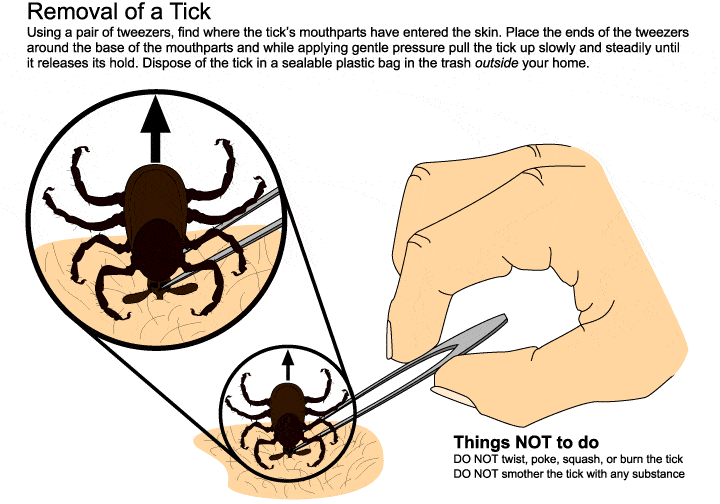
Use tweezers (fine, small, and pointed) or forceps to disengage the tick. Typical eyebrow tweezers with a blunt edge are too large. It is recommended to use tight skin gloves like latex gloves.
- Pull the tick off with gentle pressure, do not twist or pull too forcefully, so you do not tear the tick and leave the mouthparts.
- Using the forceps/tweezers, grip as close to the tip of the head as possible and gently and steadily lift the tick off the surface.
- The goal is to pull off the whole tick in one unit. Do not squash or crush the tick. This could leave harmful bacteria.
- Clean the area with warm soapy water, rubbing alcohol, or an iodine scrub.
Key Takeaway
Tick control requires a multi-pronged approach which may involve treating the pet, the yard, and inside the home.
Prevent Ticks
- If at all possible, avoid known tick habitats during tick season.
- Avoid sitting on the ground or logs in areas with brush and long grass.
- Keep grass cut short and repair any cracks and crevices where ticks may be hiding.
- Remove leaf litter
- Dispose of empty bird or rodent nesting materials (since ticks infest these materials)
- Use a tick repellent on clothing and tick repellents. Even with these repellents, you should check your bodies closely twice a day and remove them if you are in tick-infested areas.
- The infested house and kennel should be thoroughly cleaned to eliminate as many ticks as possible. Vacuuming is very helpful inside. Pet bedding and pet areas should be cleaned well.
- Kennels, dog houses, and structures occupied by pets should be thoroughly treated to control ticks that have dropped off the dog and reside in harborage areas.
- Residual insecticide sprays and dust should be applied carefully to all potential tick harborage areas.
- Long-sleeved shirts and long pants should be worn in a tick-infested area, with pants tucked into socks or boots. Choose light-colored clothing; it makes it easier to spot ticks.
- Visually inspect your clothes and body after leaving a tick-infested area. Make sure to check the base of the head's skull and back, where ticks may hide from hair.
- Wash clothes immediately in warm water and detergent after leaving a tick-infested area. Make sure to place items in a dryer; many ticks can survive a warm water washing but will not survive one hour in the dryer.
Tick Biology and Behavior
There are several species that vary in appearance, but all of the adults are small, round with eight legs. All ticks feed exclusively on the blood of vertebrates and are blood feeders. There are two families of ticks: hard ticks and soft ticks.
They have four stages in their life: egg, larva, nymph, and adult. Most ticks have a 3-host life cycle, with the larvae, nymphs, and adults feeding on the host and taking a single blood meal. The adults feed on larger hosts, while the larvae and nymphs feed on small to medium-sized hosts. Tick life cycle's complete in 1-3 years.
The adult ticks mate on the body of the host animal. After the mating, the female deposits her eggs to the ground. They are called "seed ticks," with six legs when they are in the larvae stage. These larvae seek a host for a blood meal, then drop to the ground and emerge as eight-legged nymphs. Any disease-carrying pathogens are carried in all the ticks' life cycles.
- Ticks will not jump up life fleas to get a blood meal. They will grasp the host as they pass through leaves or grassy areas.
- They are picked up on the lower legs, then crawl up the body for a blood meal.
- They have to climb places like tall grasses, weeds, fences, and sides of buildings waiting for a suitable host to pass by.
- They can detect host odors, vibrations, and exhaled carbon dioxide and fall or climb to a passing host.
- They lodge into cracks and crevices below shingles, window moldings, sidings, and wait for a passing host.
It is important to treat all cracks and crevices with the recommended insecticides. They can also be brought inside on clothing and survive for six months with a 93-100% relative humidity. Still, many ticks will die inside when the humidity is kept at less than 65%.
Tick Bites and Diseases
Ticks can carry serious diseases. According to the CDC, more than 23,000 human cases of Lyme disease were recorded in 2002, with an estimated 9 out of 10 cases going unreported. This disease was first recognized and reported around Lyme, Ct. in 1975. Since then, three areas in the United States are now identified where this disease organism is known to occur naturally. These are the Northeast (in coastal areas from northern Virginia to southern Maine), the north Midwest (Minnesota and Wisconsin), and the West (parts of California, Oregon, Utah, and Nevada). Most cases occur in the northeastern United States. Still, cases have been reported in at least 49 states, and federal health agencies (CDC) report that Lyme disease accounts for 95% of the reported vector-borne illnesses in the United States.
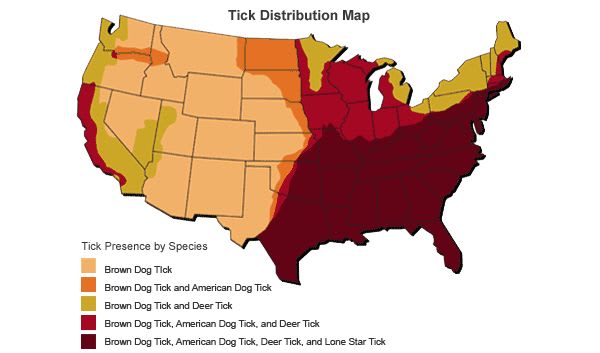
Lyme disease is caused by a spirochete(a type of bacteria-Borrelia burgdorferi) that affects humans and their pet dogs and wildlife species. In the eastern and midwestern United States, this disease organism is caused principally by a hard tick, which commonly attacks white-tailed deer and rodent species. In the Pacific coastal areas is caused by a similar bacteria called Ixodes pacific us. These ticks have a two-year cycle.
Control against this tick in your yard would be the same type of control suggested for the Brown Dog Tick. They commonly attach to the animal's body; after feeding, they drop to the ground, searching for protective areas. The areas should be sprayed with a residual insecticide. Lyme disease and tips for prevention are found on the CDC web site. Once infected with Lyme disease, a person may experience flu-like symptoms and develop a red rash in the shape of a bull's eye. Because Lyme disease's symptoms so closely mimic the flu, it often goes undiagnosed. It can lead to more severe health problems if left untreated. Tick bites also cause Rocky Mountain spotted fever, Colorado tick fever, Human granulocytic and momocytic ehrlichiosis, Babesiosis, relapsing fever, Tularemia, and Q fever.
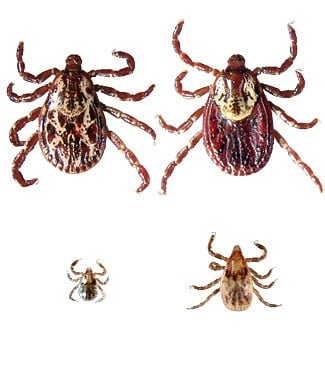
American Dog Tick
Use tweezers (fine, small, and pointed) or forceps to disengage the tick. Typical eyebrow tweezers
Dogs are the preferred host of adults of this tick species, but they will feed on larger animals. This tick is a carrier of the causal organism of Rocky Mountain Spotted Fever.
American Dog Tick Image: Courtesy of The University of Rhode Island
American Tick Bite Symptoms
Symptoms appear 3 to 12 days after tick contact. There is a sudden onset of symptoms that include fever, headache, and aching muscles. A rash usually develops on the wrists and ankles on the second or third day of fever. The rash then spreads to involve the rest of the body, including the palms and soles. If you experience fever following tick contact, see your physician. It is essential to receive the appropriate antibiotics as soon as possible if spotted fever is suspected. Most fatalities can be attributed to a delay in seeking medical attention. It occurs throughout the eastern and the central United States.
Since ticks must be in high humidity areas to survive, they are most commonly found in grassy, brushy, wooded, and shaded areas. Therefore, reducing the humidity in these areas by keeping grass well-clipped, removing brush, and pruning trees to allow more sunlight to penetrate the soil surface will discourage ticks from becoming established in these areas. Control of American dog ticks in outdoor areas is challenging. While several insecticides are labeled for outdoor tick control, they are usually not effective in eliminating large numbers of ticks in brushy, heavily wooded areas.
There are, however, some management techniques that can discourage a buildup of ticks in these areas. Modifying the habitat is a more permanent approach to tick management. Use topical tick treatments and sprays on dogs and regularly examine them for ticks and wash their bedding.
- The American dog tick goes through an egg, larva, nymph, and adult stage during its development.
- While they may be found throughout the year, adults are most active during late April through May.
- The immature stages may feed on these same hosts but prefer to infest smaller mammals such as meadow mice, squirrels, and chipmunks.
- All stages of the American dog tick will also feed on humans if given the opportunity.
- They do not transmit Lyme disease. Although dog ticks do not carry Lyme disease, they are the primary carrier of Rocky Mountain Spotted Fever in the midwest states.
- Cutting vegetation and grass short will increase the effectiveness of chemical treatments.
- Wisdom TC, Bifen IT and Permethrin SFR are recommended products.
Brown Dog Tick
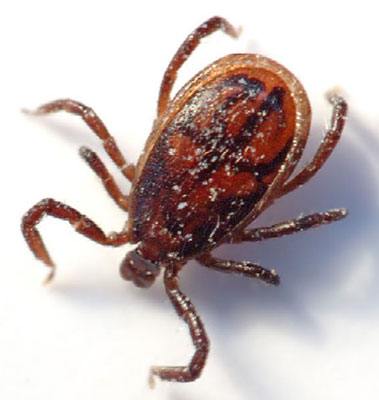
The Brown Dog Tick is the most widely distributed ticks in the world. It is unusual among ticks in that it can complete its entire life cycle indoors. Thus, it can establish populations in colder climates and have been found in many different climates. Brown dog ticks can be found outdoors in the southern USA during any time of the year but found active outdoors during the warm months in the northern USA. This tick cannot overwinter in the more north United States except within a heated structure.
Description
It is small, red-brown in color, uniform in color. Its mouthparts are easily seen when viewed from above. The body is flattened and shaped like a teardrop.
Habits
Many tick species can be carried indoors on animals but cannot complete their entire life cycle inside. Dogs are the preferred host in the US. The adults attach to the ears and between the toes, and the larvae and nymphs are often found in hair along the back. However, they are not restricted to these parts.
Once an infestation occurs inside a home, it can grow very rapidly. Typically, a few ticks are brought into the house or from an infested kennel, open field, or another place where tick-infested dogs have been located. A home can become infested if the family dog picks up ticks from an infested residence, boarding kennel, open fields, or similar place where other infected dogs have been located. Another infested dog may visit the residence, during which time some ticks may drop off. In this case, the home and yard may become infested even though a dog is not generally kept there.
After the ticks have engorged on a blood meal, they drop from the host and seek some protected situation in the immediate surroundings. For this reason, they may be found behind baseboards, under the window and door moldings, in window pulley openings, or in furniture.
- All cracks and crevices in an infested premise must be treated for reasonable control. All tick life stages may be found behind baseboards, around window door moldings, or in furniture. Newly hatched larvae can climb, so all cracks and crevices need to be treated.
- If pet bedding is infected, wash, or dispose. Use appropriate pet treatment on the dogs and bedding.
- All stages of the American dog tick will also feed on humans if given the opportunity.
- Dogs do not become infested with brown dog ticks by direct contact with other dogs.
- Ticks feeding on a dog drop off and molt before they resume host-seeking behavior and attach to another dog.
Inside Treatment: Pivot Aerosol or FenvaStar EcoCap
Outside Treatment: Wisdom TC, Bifen IT and Permethrin SFR are recommended products.
Written by our resident pest control expert Ken Martin.