






Pavement Ants
How to get rid of Pavement Ants in the house with professional ant control products.

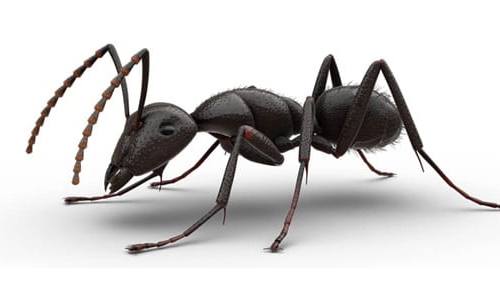
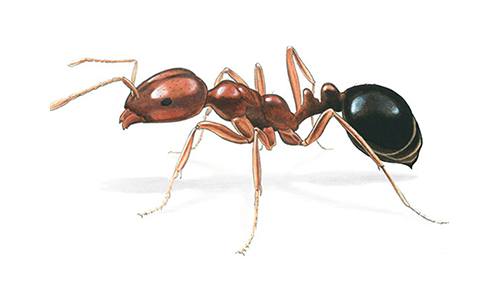
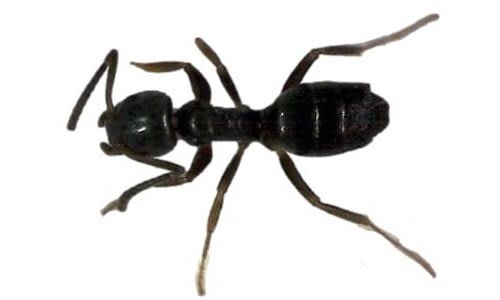
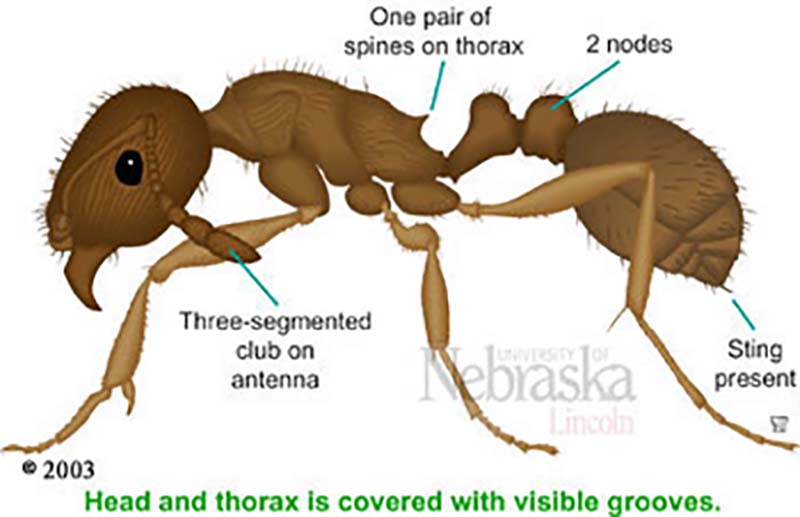
Pavement ants, which usually make their homes in pavements, are small (1/8–1/16-inch long). They are black-brown ants, with paler legs and antennae. The abdomen is all black. They are distinguished by two spines on the back, two nodes on the petiole, and grooves on the head and thorax. The colonies can be moderately large. Swarmers usually appear in June or July; however, they have been reported at other times of the year.
- Workers: Small, light to dark brown; about 1/8th inch
- Workers: Linear marks on head and dorsal area
- 2 nodes
- Antennae: Looking closely, you will see 12 segments on antennae
- One pair of spines on thorax
- Key identifying characteristic: heavy sculpturing on the head and thorax with many parallel grooves. These grooves may be seen using a 30x hand lens
- Key Biology Point: Pavement ants nest beside and under sidewalks, driveways, and building foundations.
Pavement Ant Inspection to Locate Trails or Colonies
- Pavement ants are active foragers and forage in well-established trails.
- These ants feed on a wide variety of foods, such as dead insects, greasy foods, sweets, and seeds. A favorite food source is honeydew produced by insects. They commonly feed on pet food.
- They enter through exterior foundation cracks, weep holes, and under doorways.
- To bait with the recommended ant baits properly, it is necessary to put the bait out near their colonies or trails.
- Although you may observe these Pavement ants trailing during the day, most observations will occur at night. They mostly forage at night.
- Pavement ants will displace soil around concrete objects such as sidewalks, patios, driveways, curbs, etc. This displaced loose soil may be seen along the cracks or joints in the sidewalks or driveways. Displaced soil near the side of the door threshold plate indicates an ant colony is present.
- The soil will also be brought inside the home, appearing in little piles under carpets, edges of baseboards, or behind furniture.
- Pavement ants have been found in old termite-damaged wood. They will remove the soil that the termites had gathered and dump it in piles outside the damaged wood.
- Look for colonies around the foundations of your home and underneath brick patios. Also, inspect around logs or large rocks.
- Inside, look around baseboards, plumbing, sinks, toilets, and along the edges of carpets. They also may be found in the insulation of attics and wall voids.
- Foraging Pavement ants that are foraging are active near door frames and on the floor. During the warming spring months, winged females and males are swarming inside and become trapped near a window, near the sunlight.
- Pavement ants set up trails to and from food sources. Inside structures, they are commonly found foraging under carpet edges and baseboards.
- Pavement ants will forage in heated buildings throughout the year but are more numerous during the summer.
Pavement Ant Identification
Nesting Habits
You can find their nests outdoors along curb edges, cracks in the pavement (especially when the pavement cracks are next to the lawn).Some of these nests may have openings surrounded by soil.
They may nest under a slab foundation, piling excavated soil in a mound on top of the concrete near stress cracks and expansion joints.
Pavement ant colonies may be found on anything lying on the ground, such as boards, firewood, stones, and bricks. They will readily nest under piles of leaf litter and mulch in landscaped areas.
Pavement ants may nest inside a crack or crevice close to a heat source during the winter months, such as a radiator or near sub-slab heat ducks.
Insecticide Usage
Unless you use a residual non-repellent spray such as Taurus SC, baiting is the preferred treatment over typical residual spraying.
- Typical residual repellent insecticides such as Cyper WSP or Demon WP will only kill a few and scatter the colony. Baiting is the most reliable way to eliminate the entire colony, if not choosing a non-repellent spray. When choosing ant baits, it is best to choose from both the sugar-based baits and protein/grease-based baits. If using a spray, choose a non-repellent type, unless you limit your treatment to thoroughly drenching the mounds.
Perimeter Spraying
Perimeter Spraying: If you want to stop the ants from coming inside, it is best to stop them with a perimeter residual non-repellent spray. Top recommendations would be Taurus SC (Fipronil 9.1%) or Dominion 2L (Imidacloprid 21.4%) outside and around the perimeter of your home. Usually, spraying the perimeter is enough treatment for Pavement ant control.
- If they are inside, as they will go outside, they will cross over the insecticide.
- If you need any insecticide inside, use Spectre PS or Phantom Aerosol in cracks and crevices in the inside areas.
Yard Spraying
Perimeter and Yard Spraying: If you need to spray the general outside, Dominon 2L (Imidacloprid 21.4% ) is another non-repellent that is not limited to just perimeter spraying, but may be applied on the yard and bushes. If mounds are found, Dominion 2L may be mixed as a drenching solution in a bucket and poured into the mound. Mix about 1/2 oz per gallon of water and use enough volume of water to drench the mound. For general spraying, use 1/2 oz. and spray yard and shrubs.
- If you need perimeter spraying, Taurus SC with Fipronil would be the top recommendation, but they do not have a label to spray on the grounds. Use Dominion 2L if you need additional coverage on the ground or mounds.
- Non-Repellent insecticides are best for ants and termites because these insects can not detect it and will not try to escape the insecticide. Non-repellent insecticides can't be smelled, tasted, or even felt by Pavement Ants.
- Another advantage of using a non-repellent insecticide such as Taurus, Fuse, Dominon 2L,Sprectre PS, or Phantom for Pavement ant control, is that you can use ant baits near it. Repellent insecticides do not combine well with insect baits because they contaminate the lures inside the baits; that is not the case with non-repellents.
Diet
The Pavement Ant diet consists of honeydew, insects, sweets, fruit, and greasy foods. They will also eat pet foods.
Behavior and Distribution
Throughout the Atlantic coastal region, the Pavement ant is found in the mid-western United States and the West Coast. Sometimes they can also be found in the southern United States.
As their name indicates, nests are found outside under cracks of pavement, under stones, and next to buildings. Occasionally they may be found in walls, under floors, and in insulation.
If your home is a slab-on-grade construction, Pavement ant foragers enter through cracks in slabs or other openings. They often enter buildings through expansion joints in slabs.
- They move in small motions
- Their trails are most easily spotted at night
- Look at plumbing pipes and electrical wires for their trails
- During the spring, are highly aggressive against other ants
How to Get Rid of Pavement Ants
Recommended Odorous Ant Baits (Sweet and Protein/Grease Feeding Cycles
Why Ant Bait?
The use of residual sprays or dusts (not non-repellent insecticides) causes stress in the ant colonies, causing them to split into sub-colonies and scatter. This scattering, also called budding, multiplies the Ant colonies' number and thereby multiplies your ant problem.
When you bait, use a slow-acting bait. Quick-kill insecticides and baits will only kill the foraging ants, not allowing those worker Ants to take the bait back home to feed the queen, nest workers, and brood.
If the ant bait you are currently using is not effective (if the ants are not visiting the bait), you will need to change the bait.
Slow-acting baits provide a variety of the foods the ants find in nature. Examples are other insects (proteins/grease-based baits), nectar, aphid honeydew, and plant products (sugar and carbohydrates found in sweet-based baits).
Choosing a bait requires an understanding of the nutritional needs of the colony. To be sure that you have all the baiting needs met, you may want to be ready with a sugar/carbohydrate-based bait, a grease/fat-based bait, and a protein-based bait.
IMPORTANT NOTE: REMOVE ALL OTHER FOOD COMPETITION WHEN BAITING AND LEAVE THE BAIT ALONE ONCE THE ANTS START FEEDING ON IT.
Combination Kits (Contain both protein-base and sweet-base baits)
Protein/Grease feeding cycles
- The top recommendation from the protein/grease category is Advion Ant Bait Arena, Maxforce Compete, or Invict Xpress (Outside and Inside)
- Make sure to clean kitchen counters and kitchen floor to remove any sugar, grease, or crumbs.
- As with all ant prevention, trim away any tree branches and shrubs that may be touching your home. Ants can use them as pathways to the inside of your house.
- Seal up cracks and crevices around windows, doors, and the foundation of your house.
- All ants are attracted to water, so fix any leaky plumbing and remove pet bowls.

Sweet Feeding Cycles
- To recommendation from the sweet feeding category is Advion Ant Bait Gel, followed by Optigard Ant Bait Gel


How To Prevent Pavement Ants
Pro Tips-Pavement Ant Control
- Remember to inspect first by looking for ant trails.
- If your ants are nesting outside, but coming inside to forage for food, spray a non-repellent liquid residual insecticide like Taurus SC or Fuse SC around the perimeter of your house and entry points.
- If they are already nesting inside, use both a sweet-based ant bait like Optigard Ant Bait Gel or Advion Ant Bait Gel and a protein-based bait like Advion Ant Bait Arena or Advance 375A Ant Bait. Using these baits will mimic their natural hunt for sugary sources like honeydew or protein sources like dead insects.
- When using baits, it is essential to remove any competing food sources like spills from cokes, honey, syrups, and any greasy spots.
- If you wish to spray inside, use a non-repellent aerosol like Spectre PS in any wall voids where they may be nesting. This spray will not contaminate any bait choices.