


Click on image for larger size
House Fly and Related Flies
Biology:
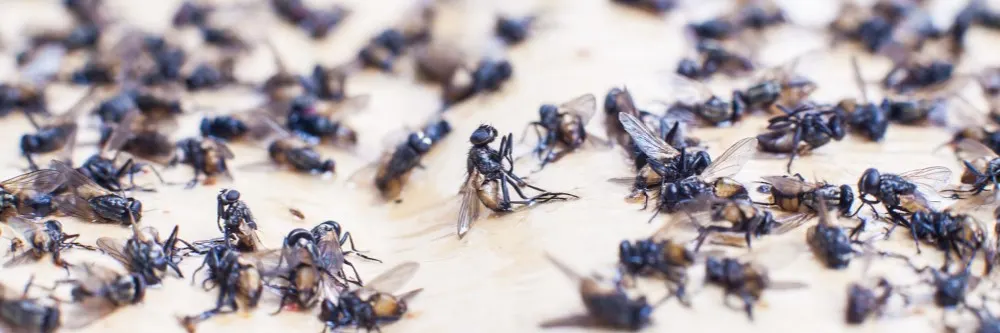
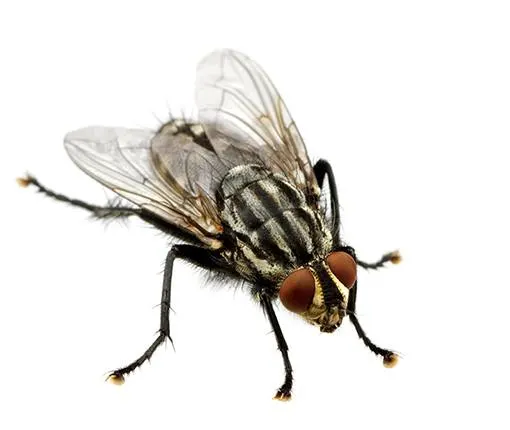
The common house fly, is a pest all over the world.
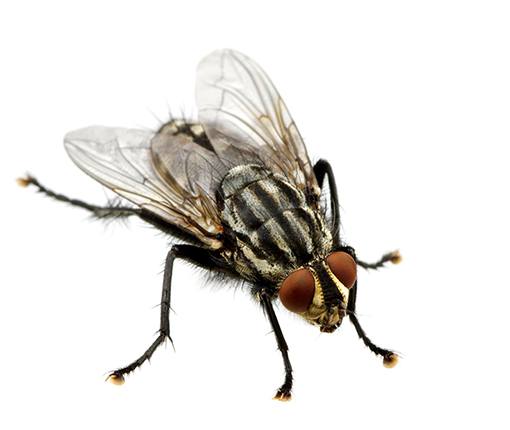
The adult has the fourth wing vein sharply angled and four length-wise
dark stripes on the top of the thorax. Its face has two velvety tripes
which are silver above and gold below. Each adult female begins laying
eggs a few days after hatching, laying a total of five to six batches
of 75 to 100 small., white oval eggs. In warm weather these hatch in
12 to 24 hours into cream-colored larvae which burrow into the food
material on which they hatched. These larvae grow and pupate in 4 to
7 days in warm weather. The mature larva contracts until its skin forms
a case about 1/4 inch long. Inside this case, the true pupa forms.When
fully formed, the adult fly breaks open the end of the pupal case and
emerges. It is ready to mate within in a few hours after merging. The
hardened larval skin which is left behind still exhibits most of the
characteristics which are used in larval identification; thus determination
can often be made on the basis of the skin alone.
During warm weather two or more generations may be completed in a month. Normally
the population builds up and is greatest in early fall months. The method of
over wintering is not well understood, but in some areas populations develop
indoors throughout the winter. House fly eggs are laid in almost any warm moist
material which will furnish suitable food for the growing larvae. Animal manure,
human excrement, garbage, decaying vegetable material and ground contaminated
with such organic mater are suitable materials.
Although they are attracted to a wide variety of food materials, house flies
have mouthparts which enable them to ingest only liquid materials. Solid materials
are liquefied by means of regurgitated saliva. This liquefied food is then drawn
up by the mouthparts and passed onto the digestive tract.
During daylight hours house flies will rest on floors, walls and ceilings indoors.
Outdoors they will rest on plants, on the ground, on fence wires, garbage cans
and other similar surfaces. At night they will rest principally on ceilings,
electric wires and dangling light cords indoors. In all situations they prefer
corners and edges or thin objects such as wires and strings. Night resting places
are usually near daytime sources of food and are usually 5 to 15 feet off the
ground.
Recommended Control Measures
Exclusion
and Sanitation, Insecticides, Traps, and Aerosols
1.
Exclusion and Sanitation:
- Sanitation
is the first measure of defense, even though there are various traps
and sprays that are used to kill flies, it is necessary to eliminate
the source in order to eliminate them.
- Whenever
possible, food and materials on which the flies can lay their eggs
must be removed, destroyed, as a breeding medium, or isolated from
the egg-laying adult. Killing adult flies will reduce infestation,
but elimination of breeding areas is necessary for good management.
- The
key to controlling these infestations is to locate and eliminate their
breeding sources.
.
- Garbage
cans and dumpsters should have tight-fitting lids and be cleaned regularly.
- Drainage
will often aid control, getting rid of extra moisture.
- Openings
of buildings should be tightly screened with screen.
.
2. Insecticides : Residual and Contract
DEMON
WP or CYPER WP are wettable powders, mixed with water to spray exterior surfaces
where flies would land, sprayed once a month.
We also carry fogging material and professional fogger equipment: FOGGING
MATERIAL AND EQUIPMENT
3. Trapping-Glue and Outside
FLY
PAPER-1 ribbon=3 ft.x1 inch strip of sticky paper .
WINDOW
FLY TRAP-allows you to use a trap to stick on the window, without using
an insecticide.
ADVANTAGE
FLY TRAP is an excellent trap for the outside, with a unique attractant
lure included.
It will trap house flies, blow flies and a broad range of other fly species:
3. Electronic traps: Inside Use These electronic fly traps are very efficient
and functional:
EXCALIBUR HLO80 SPLASHPROOF-COMMERICAL MODEL
EXOCUTOR
EX 30 ELECTRONIC FLY TRAP
COMMERCIAL
FLY TRAP-FT 30
INSECTALITE 18 WATT PROFESSIONAL
FLY TRAP and the INSECTALITE 30 WATT PROFESSIONAL
FLY TRAP
REFLECTOR FLY TRAP
4. Fly Baits :
A recommended fly bait would be: STIMUKIL
FLY BAIT
5. Aerosols
Pyrethrin contact aerosols would be:
V ONE PYRETHRUM
/ AUTOMATIC
AIR GUARD DISPENSER is an automatic dispenser to be used with
the the
V Tech Mist Metered Aerosol.
The V Tech Mist Metered aerosol will last 30 days.
Place the Advantage fly trap and the Stimukil fly bait away from areas that
you want to see flies, in that they have attractants that will draw the flies.
You will want to place the Advantage trap in sunny area on cooler days and shady
areas on warmer days. The Advantage trap is designed to be hung. Call for further
information as each situation is very different with perhaps different product
recommendations.
Click on image for larger image
STABLE FLY
The
STABLE FLY can be easily distinguished from other common domestic flies
by the long, pointed proboscis which extends in front of the head. Both
males and females use this proboscis to pierce the skin of a host and
suck blood. The bite is painful and outdoor human activity may be curtailed
when these flies are numerous. Eggs are laid in sch places as decaying
hay, straw, fermenting weeds, grass and sea weeds. Stable flies are
commonly found around stables and houses, and also along the seashore
and near dog kennels. In these last woe areas they are frequently called
biting beach flies and dog flies. The eggs hatch from 1 to 3 days into
yellowish-white maggots or larvae. These larvae pass through 3 instars
and pupate in the last larval skin. In warm weather the pupal stage
lasts 6 to 20 days. The average adult lives about 20 days. The false
stable flies and dump flies may also be problems in certain areas. They
are non-biting flies.
Little
House Flies and Latrine Flies
Biology:
These flies usually appear in the early spring before the house fly has become
numerous. These species are smaller that the house fly, more slender in appearance
and the fourth vein extends directly to the edge of the wing instead of curving
sharply upward as in the house fly. Eggs are laid in animal excrement and decaying
vegetation and sometime in vats in cheese plants. The little house fly is frequently
seen hovering in midair or darting about in the middle of a room. It differs
from the house in that it is found throughout the house and very seldom on a
spread table. This species lays it eggs on decaying vegetable matter and excrement,
particularly of chickens, human, horses and cows. The larvae emerge in about
24 hours and may be recognized as a flattened, spiny organism about 6 mm long
when full-grown. The pupal period lasts about 7 days under favorable conditions.
The complete life cycle last 15 to 30 days. The Latrine fly, is very similar
to the little house fly, but the latrine fly adult is slightly larger. Its biology
and habits are also the same.
Control Measures :
Click on image for larger size
Flesh Flies
Biology:
As a group, flesh flies occur throughout most areas of the world although
species distribution varies. Flesh flies are found in urban and rural communities
but fortunately, are relatively uncommon in houses or restaurants. They breed
in excrement, decaying vegetable matter and animal flesh or meat. Though they
can carry leprosy bacilli, flesh flies usually are not problems as disease
carriers or even as nuisances and pose little threat to human welfare or to
livestock. Some species can cause intestinal pseudomyiasis in humans who consume
food contaminated with larvae. Flesh flies are medium to large sized flies
and usually have three dark thoracic stripes and mottled abdomens. Many of
the common species have a red tip on the abdomen. Though some species may
be smaller than house flies, most flesh flies are about 1/3 to 1/2 inch long.
Flesh flies retain their eggs within the body of the female until they are
ready to hatch, The larvae are deposited directly onto the food, the immature
will be eating. The life cycle for the common species can be completed in
eight to 21 days. The preferred breeding media around residences are decayed
flesh, spoiling meat, and manure. Usually garbage can meat scraps and dog
food left outside are abundant sources of flesh fly breeding. Flesh flies
can breed in dead rodents and birds in attics or wall voids of houses.
Adult flies do not bite but feed on a wide range of liquid substances. Most
larvae infest wounds, carrion or excrement. The larvae of some species of
flesh flies are beneficial in that they prey on eggs, nymphs or larvae of
more harmful insects. Lesser house fly and blow fly larvae, and grasshopper
nymphs are common hosts of flesh flies.
Flesh fly life histories vary wit species and location. They over winter as
pupae in temperate climates. Rarely very numerous. the flies emerge In spring
and mate. Eggs are laid only under very unusual circumstances. As a rule,
eggs hatch within the body of the adult. Females of most species deposit 20
to 40 larvae directly onto the host or substitute. As many as 325 larvae have
been known to be born by a single female. Flesh fly maggots feed for three
or four days and develop though three instars. Soon afterward, these mature
maggots enter the pupae stage. Adult flies emerge in ten to 14 days and the
life cycle is repeated. Several generations are produced each. year. Flesh
flies rarely require chemical control. The burial or destruction of carcasses,
manure heaps and mounds of decaying organic matter eliminates many favorable
breeding sites. Proper treatment of wounds also helps to prevent flesh fly
harm to animals
Control Measures:
Click on image for larger size.
Blow Flies
Biology:
Blow Fly, any of a large family of flies known for the habit of the larvae,
or immature flies of, infesting animal carcasses. They are found worldwide,
occurring nearly every place inhabited by people. Blow flies are slightly
larger than true house flies, and the bodies of many are metallic blue or
green in color. Worldwide, there are about 1200 species of blow flies, and
in North America there are 80. In many areas such as the American Southwest,
blow flies are the most common type of flies found in and around houses and
other human habitations.
Blow flies range in length from 7 to 16 mm (0.28 to 0.63 in); they have robust
bodies and wide heads. The name blow fly comes from the bloated condition
of the rotting animal carcasses that their larvae, known as maggots, infest.
The most frequent species found under these conditions is the common blow
fly. Adult blow flies feed primarily on flower nectar, plant sap, and other
sugary materials. The female blow fly typically lays her eggs on the body
of a recently killed animal. The eggs hatch quickly and the maggots then feed
on the decaying tissues.
In warm weather, some species can complete their larval growth within a week.
They then burrow into the soil and pupate, to emerge later as adult flies.
Blow flies play an essential role in nature by decomposing dead tissue. The
cluster fly species of blow fly is an exception: its larvae prey on earthworms.
Blow flies have played a role in medicine: species such as the green bottle
fly and the black blow fly were once commonly used to clean open wounds in
humans because the maggots tend to feed only on decayed tissue. Some blow
fly species, such as the screw worm fly, lay their eggs on living animals.
The maggots then feed on the animal's healthy tissue. Because blow flies routinely
move between dead animals or dung and human habitats, they may transmit disease
organisms to people, including the bacteria that cause dysentery, typhus,
and cholera.
Control Measures:
Drain Flies

Also called moth flies, sewer flies or filter flies these true flies have
bodies and wings covered with numerous hairs. If crushed they leave a powdery
smudge
Drain flies, or moth flies, can be found in
moist, highly organic debris areas such as sink drains, sewage treatment facilities,
storm drains, dung and rotten vegetation.
Adults range in size from 1/16 to ¼ inch . They may be yellow
to brown /black in color.
During daylight, they will often be found resting on walls
near drains.
Adult female drain /moth flies most often lay their eggs in
masses on the surface of gelatinous film found in drains and sewers.
They may also breed in moist, shady areas outdoors such as
under potted plants, in bird feeders and baths, in moss, in clogged roof gutters,
under air conditioners, in thick mulch, or on wet ground areas.
The larvae feed on decaying material that collects in drains. In natural
settings, moth fly larvae feed on decaying plants and animals. Most moth flies
are harmless to humans, though they may transmit bacteria and other microorganisms
from their breeding sites to areas where people are. Moth flies do not bite.
Adults live about two weeks
Control
Finding the sources of breeding and eliminating them
is the best control.
Floor drains, overflow cuts in sinks and tubs, sump pump pits and sewers
can accumulate organic matter but often do not receive enough water to flush
the waste down the drain.
They may be common in laundry and floor drains, toilet and shower drains.
The drain/moth fly larvae feed on the sides
of the drain and in the drain trap if there is an accumulation of organic
debris there. You can check it by placing some tape over the opening (leave
some opening for air flow). If you find these flies stuck to the tape , you
have discovered the source.
Pouring bleach down the drain is not effective. A bacterial digester like
DF
5000 DRAIN CLEANER may be used to break up the organic debris.
Re-grouting tiles to prevent water seepage into walls will stop breeding
in those sites. If found in rotting vegetable matter, the source should be
destroyed.
Clean dirty garbage containers, wet lint under the washing machine, and even
standing water in containers under houseplant pots. Outside the home, inspect
air conditioners, bird baths, shallow stagnant pools of water and sewage treatment
facilities upwind as adult flies will travel with the wind.
If adults do not disappear within a week further treatments or looking
for other breeding sources is needed .
To control the adult flies flying in the air a pyrethrum aerosol like V TECH MIST would be helpful in spraying the adult flies.
This aerosol is metered and can be used in a automatic dispense unit like
AUTOMATIC
AEROSOL DISPENSER or hand held.
Drain Fly Kit
We have the DF
5000 Drain Cleaner and the V One Aerosol in one kit called the Drain Fly
Kit.
Fruit Flies
Fruit Flies

Size: (3mm)
Key Identification:
Biology and Habits:
Recommended Control Measures
Fruit flies are small about 1/8-inch in length including the wings.
Key Identification:
- A key identifying character is its bright red eyes.
- The Fruit fly is about one third the size of the house or filth fly.
Color:
- Body color is usually a light yellow to tan color.
Biology and Habits:
- The fruit flies comprise several different species belonging to the genus
Drosophila. The most common species encountered in homes and other
structures is D.melanogaster. Fruit flies are also identified as
pomace flies or vinegar flies. These pests can be found throughout the world,
in homes, food processing plants, warehouses, grocery stores, wineries,
restaurants and other structures.
- Populations tend to be greatest in late summer and early fall as they
infest fruits during the harvest season.
- Fruit flies are among the smallest flies found in homes.
- With the end of the summer season, many homeowners often encounter fruit
flies in and about their kitchens and near garbage storage areas.
- They are generally found hovering around decaying vegetation and overripe
fruit.
Fruit flies most often are found hovering around overly ripe fruit.
Fermenting materials, such as leftover beer or soft drinks, also are a favorite
food of these flies.
These pesky insects are often found in the kitchen, especially when vegetable
or fruit materials are present after major home canning efforts.
- Occasionally, pomace flies, similar in appearance to fruit flies, may
infest the home. The source of a pomace fly problem is often standing water
like a forgotten mop pail or an open sewer drain.
- Because it frequents such unsanitary areas, it could potentially carry
disease-causing bacteria onto food products.
- Like all flies, fruit flies develop by complete metamorphosis.
Eggs are laid near or on top of attractants (fermenting materials) such
as beverages, decaying fruit and vegetable matter, garbage or slime in drains.
They are attracted to any area where moisture has accumulated including
mops and wet rags. The larvae emerge from the eggs and feed near the surface
of the fermenting material for 5-6 days.
- This surface-feeding characteristic of the larvae is significant in that
damaged or over-ripened portions of fruits and vegetables can be cut away
without having to discard the remainder for fear of retaining any developing
larvae.
However eating the larvae can cause intestinal discomfort and diarrhea.
For this reason, health professionals and sanitarians are concerned when
these flies are found infesting facilities where food is prepared, processed,
or served.
- Newly-emerged adults are attracted to lights, but egg laying females will
not leave fermenting materials. The larvae then crawl to drier areas of
the food source or even out of the food source to pupate. Under ideal conditions,
the life cycle from egg to adult can be completed in as little as eight
days.
Life cycle from egg to adult is approximately 10 days.
Recommended
Control Measures :
Exclusion
and Sanitation, Insecticides, Traps, and Aerosols
1. Exclusion
and Sanitation:
- Sanitation
is the first measure of defense, even though there are various traps and
sprays that are used to kill flies, it is necessary to eliminate the source
in order to eliminate them.
- The key to
controlling these infestations is to locate and eliminate their breeding
sources.
Whenever possible, food and materials on which the flies
can lay their eggs must be removed, destroyed, as a breeding medium, or
isolated from the egg-laying adult.
Killing adult flies will reduce infestation, but elimination
of breeding areas is necessary for good management.
- Garbage cans
and dumpsters should have tight-fitting lids and be cleaned regularly.
- Drainage will
often aid control, getting rid of extra moisture.
- Openings
of buildings should be tightly screened with screen.
- The
fruit fly larvae may feed on the sides of the drain and in the drain trap
if there is an accumulation of organic debris there. You can check it by
placing some tape over the opening (leave some opening for air flow). If
you find these flies stuck to the tape , you have discovered the source.
- Pouring bleach
down the drain is not effective.
A bacterial digester like DF
5000 may be used to break up the organic debris.
Gentrol Aerosol is an aerosol insect growth regulator to use to kill
fruit fly eggs and discourage immature fly development.
Gentrol can be applied into drains, under appliances, floor mats, around
plants, dumpsters, etc.
- . Re-grouting
tiles to prevent water seepage into walls will stop breeding in those sites.
If found in rotting vegetable matter, the source should be destroyed.
- Clean dirty
garbage containers, wet lint under the washing machine, and even standing
water in containers under houseplant pots. Outside the home, inspect air
conditioners, bird baths, shallow stagnant pools of water and sewage treatment
facilities upwind as adult flies will travel with the wind.
2. Insecticides
: Residual and Contract
DEMON
WP or Cyper
WP are wettable powders, mixed with water to spray exterior surfaces
where flies would land, sprayed once a month.
We also carry
fogging material and professional fogger equipment:
FOGGING
MATERIAL AND EQUIPMENT
3.Trapping
: 960 Vector Fruit Fly Trap
960
VECTOR FRUIT FLY TRAP
4. Aerosols
Pyrethrin contact
aerosols would be:
V ONE AEROSOL
V MIST
METERED AEROSOL / AUTOMATIC
AIR GUARD DISPENSER is an automatic dispenser to be used with
the the V Mist Metered Aerosol.
The V Mist Metered aerosol will last 30 days.

Gentrol
Aerosol is an aerosol insect growth regulator to use to kill fruit fly
eggs and discourage immature fly development.
Gentrol can be applied into drains, under appliances, floor mats, around plants,
dumpsters, etc.
Cluster Flies
IDENTIFYING
THE CLUSTER FLY
They average between 1/4 to
3/8 inch long. They are dark gray, never metallic blue or green. When
crushed, they give off an odor like buckwheat honey. Cluster flies closely
resemble house flies, but they are usually larger and have a yellowish
sheen on the thorax.
BIOLOGY AND HABITS
They are parasites of earthworms
and breed outdoors in lawns and fields during the spring and summer.
You can find them almost everywhere in the United States and Canada,
except for the Southern states bordering the Gulf of Mexico.
Females lay their eggs in cracks in the soil, which hatch in three
days. The larvae use earthworms as a food source. The larvae feed for
about 22 days. After that, they go into the pupae stage, which lasts
11-14 days before emerging as adults. Adult flies feed on flowers. There
are about four generations hatched per summer.
When fall approaches, they begin to enter structures in large numbers.
Problems with cluster flies begin in late August as they move to winter
quarters to over-winter. They are seeking warm sites with protective
cracks for shelter, crawling back as far as they can get. It is
important to consider treatment before this happens.
They have been known to squeeze around the edges of windows that are
weather-proofed. As the number of flies attracted to the building increases,
large clusters of flies huddle inside wall voids, attics, and false
ceilings. Most infestations occur in the upper regions of a buildings,
such as the attics of homes. In multi-story buildings, they can be found
in the upper two or three floors, and almost always of the south and
west sides of the buildings.
If you have unseasonably warm weather in the late fall or winter,
they may emerge thinking it is spring, going for the warmer air outside.
They fly very slowly when they just wake up. They are strongly attracted
to light, so they are usually found around windows. At night they are
attracted to lamps.
INSPECTION
Check around windows for live
or dead flies. If you can find the voids in which they are over-wintering,
you can treat the voids with a dust or aerosol, but that is not an easy
task. In most cases, the voids can't be located.
To locate the voids, start with
an inspection of cracks and crevices on the southern and western exterior
walls. Usually the only accessible voids are the attics, crawls paces and
false ceilings.
CONTROL MEASURES:
Cluster fly problems can be partially prevented, but after the fall
little can be done. All of those currently found within the home had
infiltrated walls months ago.
A "mini-vac" is the best control of the individual flies that are currently
present.
If this is not successful an aerosol like CB-80 pryethrum
contact aerosol can be used. Spray lightly and repeat spray as needed.
An alternate would be electronic fly traps such as:
COMMERCIAL
FLY TRAP-FT 30
INSECTALITE 18 WATT PROFESSIONAL
FLY TRAP and the INSECTALITE 30 WATT PROFESSIONAL
FLY TRAP
Late August and early September are the times to use a good residual spray like Suspend or Demon WP,spraying the outside walls of the building where cluster flies are likely to land and rest before entering the building.
These residual insecticides are applied outdoors to window frames, door frames, soffits and eaves as well as any other areas that are vulnerable to entry.
Application of to the surrounding soil may also help minimize Cluster Fly populations and later entry.
Recommended also would be a dust like Delta Dust, dusted into cracks that have not been sealed, allowing the dust to flow back into the void areas.Thoroughly caulking all exterior cracks on the sun-exposed sides (south and west) is
very important.
Deer and
Horse Fly
Biology:
Generally, Deer flies are pests of domestic and wild animals, but
will annoy and bite humans. Deer flies feed by sucking blood and cause a severely
painful bite. These flying pests are closely related to horse flies. Often confused
with Horse flies, Deer flies are a little smaller in size. The wings of this
fly have dark markings and their body is tan or dark in color. The female of
the species feeds on animal blood, while her male counterpart is a pollen collector.
Deer flies deposit their eggs in damp areas around bays, lakes, ponds or swamps.
The larvae of this fly feeds on insects and can be found developing in wet areas.
These are strong fliers and serious pests of warm-blooded
animals and people. Only the females need a blood meal. Their mouthparts are
blade like and it is painful when they cut through the skin. When the blood is
flowing from the wound they will "lap" it up. The larvae feed in a wide variety
of wet or damp sites that are high in organic material. Most females feed during
the warmer parts of the day, but some species prefer the hours at dawn or dusk.
Horse flies are larger than the deer flies and usually have clear wings while
the deer fly has dark markings on the wings.
Control: Follow the general recommendations,
however trapping Horse Flies may be difficult. The best remedy is sanitation.
Biology:
This fly belongs to a family of small to moderately large flies. People are
often alarmed by midges since they resemble mosquitoes. However, they differ
from mosquitoes in that the wings are not scaled and the mouthparts are short
and not adapted for biting. Adult midges are slender, usually less than 5 mm
long with long, slender legs and wings. Midges lay their eggs on water. The
larvae are usually aquatic, are found in quiet water such as lakes, ponds, reservoirs
and tanks, and are bottom feeders. Polluted water apparently favors their growth
and development. In the summer, eggs will hatch in about 3 days and larvae will
reach adulthood in about 4 weeks. During peak emergence, large numbers of midges
fly into residential and industrial areas causing annoyance and damage. They
are attracted to lights at night and thousands will rest on the outside of buildings
and will enter homes through the slightest crack. They fly into people's eyes,
ears and mouths and are sometimes inhaled. Everything is contaminated by midges.
Control:
Tney are rarely a problem in a balanced aquatic community.
Pollution of water, where algae grows, providing food for the larvae to feed on, results in high populations.
Fogging Materials may provide temporary relief, when proper water management is not available.
Midge invasions may also be reduced by avoiding the use of outdoor lighting to the greatest possible extent.
For those midges that are still able to find their way indoors, the residual insecticide an aerosol and fogging treatments as described in House Fly Control would apply.
Sand Flies,
No-See-Ums, Punkies
Biology:
Biting Midges,""no-see-ums," "punkies," or "sand flies" - They are very small
flies (about 1/25-1/10) inch long whose small but bladelike mouthparts make
a painful wound out of proportion to its tiny size. Welts and lesions from the
bite may last for days. The larvae of various species breed in a wide variety
of damp or wet places high in organic matter. Most are attracted to lights.
One vicious biter breeds along the Atlantic coast in salt marshes and wet soil.
Another species, found in mountainous areas, feeds in the evening and night
hours and is small enough to pass through ordinary screens. These are important
pests along coastal and mountainous areas and can seriously interfere with outdoor
activities.
Control:
Removal of breeding sources
Black
Flies
Biology:
Black Flies, or buffalo gnats - These are very small (1/25 to 1/5 inch) blood-sucking
flies that are black to gray in color. They usually bite in shaded or partially
shaded areas and may fly as far as 15 miles from breeding areas. The larvae
are found attached to under water objects in shallow, fast-running rivers and
streams. For this reason they can be very troublesome in mountainous areas.
The saliva injected while feeding causes swelling and numb- soreness that may
persist for days.
Control:
Because of the wide-spread breeding sites and long flight range of black flies,
control by homeowners is not very practical. Aerosols such as CB-80
can be used indoors for occasional invaders.
Chiggers
Biology
The chigger is a tiny red-colored mite which in its immature stage will feed
on man, rodents, birds, snakes and a wide variety of other animals. It is especially
common in second growth areas, blackberry patches and forest edges. Chiggers
are very active in crawling about looking for a host, and may crawl over the
skin for some hours before beginning to feed. When the mouthparts are inserted
into the skin, a fluid is injected that dissolves the cells upon which it feeds.
The chigger does not, as commonly believed burrow into the skin. Itching can
begin three to six hours after exposure. Examination of the skin may reveal
minute red mites moving rapidly over the surface. A soapy bath taken as soon
as their presence is noted will often remove many of them before they begin
feeding.
Control: Residual insecticides such
as SUSPEND
and DEMON
WP are labeled for Chiggers.
Phorid
Fly
Biology:
The phorid fly breeds primarily in and feeds on moist decaying organic matter.
Because it frequents unsanitary areas (with the ability to spread disease causing
bacteria onto food products) this fly is of particular concern to hospitals,
health care facilities and restaurants. The reproductive potential of these
flies is tremendous and very large numbers of them may appear in a short time.
Adult flies are strong fliers, having been known to travel as far as 6 miles
within a 24 hour period. Phorid flies are found throughout the world and are
a serious pest when found in food producing, food handling or food serving facilities.
Health care facilities are another favorite target of this fly. Phorid fly larvae
have been found in the open wounds of patients in nursing homes and hospitals.
Fermenting materials such as fruit, dirty garbage containers, rotten vegetables
or slime in drains are just a few of their favorite breeding and feeding places.
Phorid flies develop by egg, larva, pupa and adult. The female will lay about
20 eggs at a time and will lay about 40 eggs in a 12 hour period. Each adult
female phorid will lay approximately 500 eggs. The tiny eggs are deposited on
or near the surface of decaying organic matter. Larvae emerge in 24 hours and
feed for 8 to 16 days. The Phorid fly larvae then crawl to a drier spot to pupate.
The life cycle from egg to adult can be completed in as little as 14 days (under
ideal conditions) but may take as long as 37 days to complete their cycle.
Control:
Sanitation and habitat elimination are keys to managing this group of flies.
It may be difficult to locate the source of infestation since the flies can be well concealed in and around plumbing and areas where moisture may collect.
When the breeding source can not be eliminated, the use of residual insecticides such as :
DEMON WP or CYPER WP wettable powders, mixed with water to spray exterior surfaces where flies would land, sprayed once a month.
|